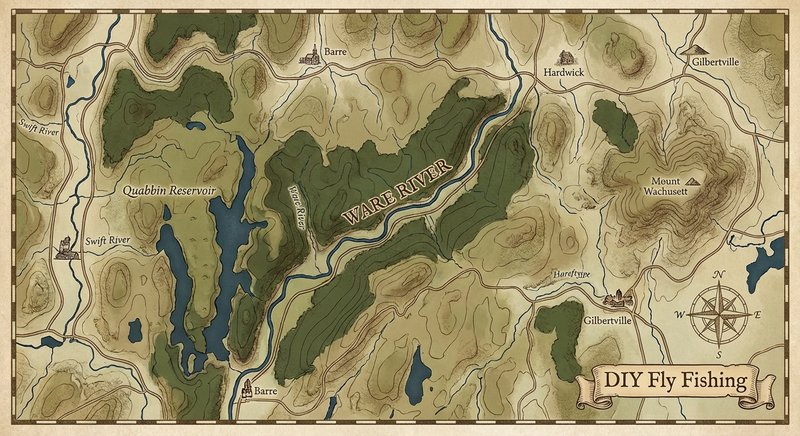
Ware River
Fly fishing in Massachusetts · Intermediate · Best seasons: Spring, Summer, Fall
Target Species
Brown Trout, Brook Trout
About This Water
Central Massachusetts stream with wild trout. Quabbin watershed.
Fishing Recommendations
The Ware River in Central Massachusetts is a gem of the Bay State, offering a classic New England freestone experience. While many anglers flock to the Swift or the Deerfield, the Ware provides a more "wild" feel with diverse water types, ranging from tumbling pocket water to long, glassy glides.
Here is your comprehensive guide to fly fishing the Ware River.
🎣 Location Overview
The Ware River originates in the hills of Barre and Hubbardston, flowing southwest through towns like Gilbertville and Hardwick before joining the Quaboag to form the Chicopee River.
What makes the Ware special is its diversity of character. The upper reaches (above Barre) feel like a mountain stream, while the middle section near Gilbertville features wide runs and deep pools. A significant portion of the river is part of the "Delayed Harvest" program, which ensures high fish densities through the spring. The river is also influenced by "Shaft 8," a massive intake structure that can divert water to the Quabbin Reservoir, occasionally impacting flows and temperatures in unique ways.
🐟 Target Species & Behavior
- Brown Trout: These are the "kings" of the Ware. While the state stocks them heavily, the Ware is known for its holdover potential. You will find wary, larger Browns (14–18 inches) tucked under undercut banks, behind large boulders, or in the deep "guts" of pools. They are opportunistic but become highly selective during specific hatches.
- Brook Trout: You will find stocked Brookies in the main stem, but the Ware's tributaries and the very upper reaches hold wild, native Brook Trout. These fish are smaller (5–9 inches), vibrantly colored, and highly aggressive. They hold in the coldest, fastest water and are often found in the "bubble line" at the head of pools.
📅 Best Times to Fish
- Spring (Mid-April – June): This is the "Prime Time." The water levels are usually healthy, and the insect life is peaking. The famous Hendrickson hatch (late April/early May) brings the largest fish to the surface.
- Summer (July – August): Fishing becomes more technical. You must focus on the early morning or late evening. Pro Tip: Carry a thermometer. If the water hits 70°F, stop fishing to protect the trout. Look for "thermal refuges"—areas where cold-water tributaries enter the main stem.
- Fall (September – October): A favorite for many guides. As water temperatures drop, Browns become aggressive ahead of the spawn. The foliage is world-class, and the crowds are thin.
🪰 Recommended Flies & Techniques
Dry Flies
- Hendrickson (Red Quill) #12-14: Essential for late April/May.
- Elk Hair Caddis #14-18: Tan or Olive. Fished with a "skittering" motion.
- Light Cahill #14-16: Great for summer evenings.
- Stimulators #8-12: Excellent as an attractor or a "hopper-dropper" lead fly in the pocket water.
Nymphs
- Pheasant Tail #14-18: The gold standard for the Ware.
- Prince Nymph #12-16: Works exceptionally well in the faster runs near Barre.
- Zebra Midge #18-22: Necessary for the slow, pressured pools in the Delayed Harvest section.
Streamers
- Woolly Bugger (Olive or Black) #6-10: Swing these through deep pools or strip them fast near undercut banks for big Browns.
- Muddler Minnow: Effective during low light to mimic sculpins or large grasshoppers.
💡 Pro Tips & Local Knowledge
- The Gilbertville Section: Focus on the stretch near the historic covered bridge. This is part of the "Delayed Harvest" area. It holds fish all year, but because it’s popular, the fish are "educated." Use long, fine leaders (9ft 5X or 6X) here.
- Pocket Water Mastery: Between Barre and Gilbertville, the river is very rocky. Don't just fish the big pools. Use "high-stick" nymphing or Euro-nymphing techniques in the small pockets of soft water behind rocks. A trout will often sit in a spot no bigger than a dinner plate.
- The Shaft 8 Influence: Check the USGS gauges. If the Quabbin intake (Shaft 8) is wide open, the river can drop significantly. Conversely, heavy rains can make the Ware turbid quickly. Always check the "Ware River at Gibbs Crossing" gauge before driving out.
⚠️ Important Information
- Access: Excellent access can be found off Route 32 and Route 122. There are several dirt pull-offs specifically for anglers. The Ware River Rail Trail provides incredible foot access to remote stretches that don't see many vehicles.
- Regulations:
- The section from the Route 122 bridge (Barre) to the downstream Bridge Street bridge (Gilbertville) is a Delayed Harvest Area.
- From January 1 through June 30: Catch and release only, artificial lures/flies only.
- Always carry a valid Massachusetts Freshwater Fishing License.
- Wading Safety: The Ware has a very "slick" bottom. Felt soles (where legal) or studded boots are highly recommended, as the rocks are covered in a fine layer of silt and algae.
Guide’s Final Word: The Ware River rewards the observant angler. If you don't see rising fish, don't leave—change to a heavy tungsten nymph and find the deep slots. The fish are there, often tucked tighter to the structure than you think!
Bug Hatches & Matching Flies
| Hatch | Type | Peak months | Time of day | Hook sizes | Matching flies |
|---|---|---|---|---|---|
| Blue Winged Olive Baetis / Pseudocloeon | mayfly | April, May, September, October | Mid-day | #18-22 | RS2 #18-22, Parachute Adams #18-22, Pheasant Tail #18-20 |
| Hendrickson Ephemerella subvariabilis | mayfly | April, May | Afternoon | #12-14 | Hendrickson Sparkle Dun #12-14, Red Quill #12-14, Hare's Ear #12-14 |
| Grannom Caddis Brachycentrus | caddis | April, May | Morning/Afternoon | #14-16 | Elk Hair Caddis (Dark) #14-16, LaFontaine's Deep Sparkle Pupa #14-16, Peacock Caddis #14-16 |
| March Brown Maccaffertium vicarium | mayfly | May, June | Afternoon/Evening | #10-12 | March Brown Dry #10-12, Gold Ribbed Hare's Ear #10-12, March Brown Wet #10-12 |
| Light Cahill Stenacron / Stenonema | mayfly | June, July | Evening | #12-14 | Light Cahill #12-14, Cahill Wet Fly #14, Pheasant Tail #14 |
| Golden Stonefly Acroneuria | stonefly | June, July | Morning/Evening | #8-12 | Pat's Rubber Legs (Yellow/Brown) #8-12, Golden Stimulator #8-12, Kaufmann's Stone #8-10 |
| Spotted Sedge Hydropsyche | caddis | June, July, August | Evening | #14-18 | Tan Elk Hair Caddis #14-18, Z-Caddis #16, Hydropsyche Larva #14-16 |
| Trico Tricorythodes | mayfly | July, August, September | Morning | #22-26 | Trico Spinner #22-24, Trico Parachute #22-26, Black Zebra Midge #22-24 |
| Eastern Pale Evening Dun Ephemerella dorothea | mayfly | June, July | Evening | #16-18 | Sulfur Parachute #16-18, Sulfur Sparkle Dun #16-18, Pheasant Tail #16-18 |
| Ants and Beetles Formicidae / Coleoptera | terrestrial | July, August, September | All Day | #12-18 | Black Foam Ant #14-18, Cinnamon Ant #16-18, Joan Wulff’s Hopper #10-14 |