Washington Lake
Fly fishing in Utah · Intermediate · Best seasons: Summer, Fall
Target Species
Arctic Grayling, Cutthroat Trout
About This Water
High Uinta lake with grayling and cutthroat. Backcountry fishing destination.
Fishing Recommendations
Welcome to the high country. As your guide, I’m excited to talk about Washington Lake. Located in the heart of the High Uinta Mountains at an elevation of approximately 10,000 feet, this is one of the premier drive-to alpine fisheries in Utah. While many anglers head to the Uintas for Brook trout, Washington Lake is the crown jewel for those looking to check the Arctic Grayling off their bucket list.
Here is your professional guide to fishing Washington Lake.
🎣 Location Overview
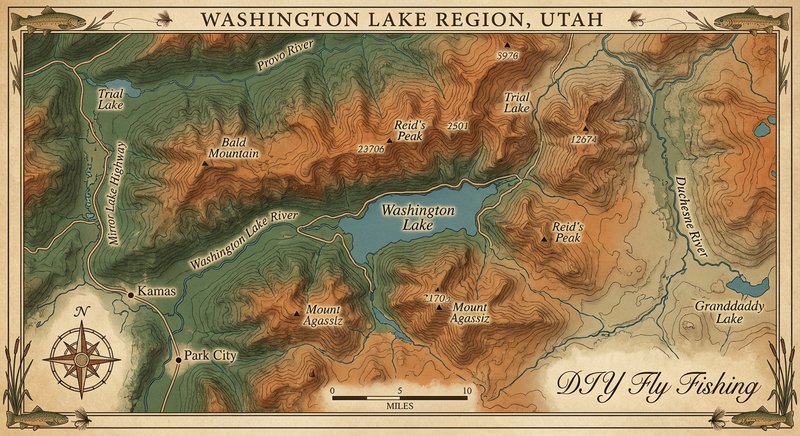
Washington Lake is a stunning alpine lake situated just off the Mirror Lake Highway (SR-150), about 30 miles east of Kamas, Utah. Unlike many high-altitude lakes that require miles of backpacking, Washington Lake offers "backcountry beauty" with easy vehicle access and a developed campground.
The water is crystal clear and cold, surrounded by lodgepole pines and dramatic quartzite peaks. What makes this water special is its accessibility to Arctic Grayling. While Grayling are usually found in remote Alaskan or Canadian wilderness, Washington Lake provides a rare opportunity to target them from a float tube or the shore in the lower 48. The lake features a mix of shallow shelf areas and deep cold pockets, creating a perfect habitat for cold-water salmonids.
🐟 Target Species & Behavior
Arctic Grayling
Grayling are the stars here. They are known for their massive, iridescent dorsal fins and their tendency to rise to dry flies even in the middle of the day.
- Behavior: They are schooling fish. If you catch one, there are likely twenty more within thirty feet.
- Feeding: They have very small mouths and a high metabolism. They focus heavily on midges, mosquitoes, and small crustaceans (scuds).
Cutthroat Trout (Bear River & Bonneville)
The Uintas are native territory for Cutthroats.
- Behavior: More predatory than Grayling. They tend to patrol the "drop-offs" where the shallow shelf meets the deep blue water.
- Feeding: While they will take dries, they are more likely to smash a leech or a terrestrial (ant/beetle) blown off the bank.
📅 Best Times to Fish
Seasons
- Summer (July – August): This is the prime window. The ice usually doesn't clear until mid-to-late June. Once the ice is off, the fish are famished. July is peak for dry fly action.
- Fall (September – Early October): My favorite time. The crowds disappear, the mosquitoes die off, and the fish begin a feeding frenzy to prepare for the long winter. The Grayling's colors are most vibrant now.
Time of Day
- Morning/Evening: The classic "glass-off" periods are best for sight-fishing to rising Grayling.
- Mid-Day: Unlike lower-elevation rivers, the high-altitude sun doesn't always put the fish down. If there is a slight breeze "riffling" the surface, the Grayling will often feed all day long.
🪰 Recommended Flies & Techniques
Top Fly Patterns
- Dry Flies:
- Griffith’s Gnat (#18-22): The absolute best "cluster midge" imitation for Grayling.
- Parachute Adams (#16-20): The gold standard.
- Black Gnat or Mosquito (#18-20): Matches the constant hatches.
- Black Foam Ant (#14-16): Lethal in the afternoon when the wind picks up.
- Nymphs/Sub-surface:
- Zebra Midge (#18-22) in Red or Black: Hang this 18 inches under a dry fly.
- Olive Scud (#16-18): Grayling love these near the bottom.
- Bead-head Pheasant Tail (#16-18): Generalist nymph that mimics almost everything in the lake.
- Streamers:
- Woolly Bugger (#10-12) in Olive or Thin Mint: Best for the larger Cutthroat Trout.
Techniques
- The "Dry-Dropper": This is the most effective way to fish Washington Lake. Use a visible dry (like an Adams) and hang a small Zebra Midge or Pheasant Tail about 2 feet below it.
- The Twitch: When fishing for Grayling, don't just let the dry fly sit still. Give it a tiny, microscopic twitch every 10 seconds. Grayling are aggressive and the movement often triggers a strike.
- Float Tubing: While shore fishing is possible, a float tube or kayak allows you to reach the "shelf breaks" where the big fish cruise.
💡 Pro Tips & Local Knowledge
- The Small Mouth Factor: Grayling have remarkably small, delicate mouths. If you use a hook larger than a #16, you will get "bumps" but no hookups. Stay small (#18 or #20) to increase your landing rate.
- Look for the "Dimples": Grayling rises don't look like trout splashes; they look like little bubbles or "dimples" on the water. Cast exactly into the ring of the rise.
- Wind is your Friend: If the water is "glassy," the fish can be spooky. A light chop on the water hides your tippet and makes the fish more confident to feed.
- The Inlet: There is a small creek entry on the north/northwest side of the lake. In early summer, fish congregate here for the oxygenated water and incoming food.
⚠️ Important Information
- Access: Located on Mirror Lake Highway. A Uinta-Wasatch-Cache National Forest pass is required ($6 for 3 days) and can be purchased at kiosks along the highway.
- Regulations: Washington Lake is subject to general Utah fishing regulations. Check the current Utah Fishing Guidebook for bag limits, though catch-and-release is highly encouraged for the Grayling to maintain the population.
- Gear Note: Even in July, it can drop to freezing at night. Bring layers. If you are float tubing, neoprene waders are highly recommended over breathable ones, as the water temperature rarely rises above 55°F.
- Handle with Care: Grayling are more delicate than trout. Use barbless hooks and try to release them without taking them out of the water. Their scales are easily damaged.
Tight lines, and enjoy the "Sailfish of the Uintas!"