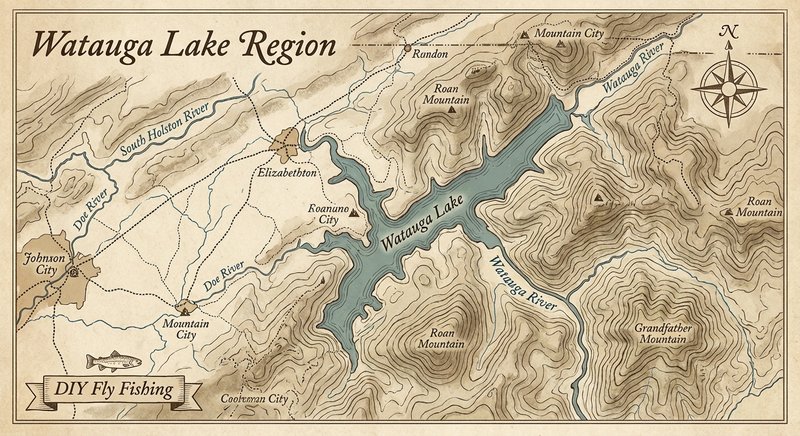
Watauga Lake
Fly fishing in Tennessee · Beginner · Best seasons: Spring, Summer, Fall
Target Species
Smallmouth Bass, Walleye, Rainbow Trout
About This Water
Clear mountain reservoir with excellent smallmouth and walleye. Scenic northeast Tennessee.
Fishing Recommendations
Watauga Lake, located in the mountains of Carter and Johnson Counties in Northeast Tennessee, is a unique gem in the TVA (Tennessee Valley Authority) system. At over 1,900 feet above sea level, it is the highest reservoir in the state, surrounded by the stunning Cherokee National Forest.
As your guide, I can tell you that Watauga is not your typical "bass pond." It is a deep, cold, highland reservoir with exceptionally clear water. This clarity and temperature profile make it one of the few places in the South where you can effectively target wild-behaving trout alongside world-class smallmouth in a lake setting.
🎣 Location Overview
Watauga Lake is characterized by its steep, rocky shorelines, deep drop-offs, and pristine water quality. Because much of the shoreline is protected by the National Forest, it remains undeveloped and rugged.
What makes it special for the fly angler is the oxygenated cold-water layer. Even in the heat of summer, the depths remain cold enough to support a robust population of Rainbow and Lake Trout. For the fly fisher, this is a "structured" game—you aren't just casting blindly; you are fishing points, submerged timber, and the mouths of cold-water tributaries like the Elk River and the Watauga River headwaters.
🐟 Target Species & Behavior
Smallmouth Bass ("Bronzebacks")
The "crown jewel" of Watauga. These fish are nomadic and thrive in the clear water.
- Behavior: They move shallow to spawn in the spring and then retreat to deep rocky ledges and submerged islands (humps) as the water warms.
- Feeding: They primarily target threadfin shad and crayfish.
Rainbow Trout
Watauga is stocked, but it also receives wild fish from its tributaries.
- Behavior: In the spring and fall, they cruise the shorelines and the surface. In summer, they retreat to the "thermocline" (usually 20–40 feet deep), requiring specialized sinking lines.
- Feeding: They focus on midge clusters, terrestrial insects blown off the forest canopy, and small baitfish.
Walleye
While traditionally a gear-guy's fish, Watauga walleye are susceptible to the fly, especially during their spring spawning run.
- Behavior: They are light-sensitive. They move into the shallow flats of the Elk River arm at night or during low-light conditions.
- Feeding: Highly piscivorous; they want shad and shiners.
📅 Best Times to Fish
- Spring (March – May): Prime Time. This is when all three species are in reachable depths. Smallmouth move to the points to spawn, and Rainbows are frequently seen rising in the coves during the morning midge hatches.
- Summer (June – August): Best for Night Fishing or very early dawn. The Smallmouth become "light shy" and the Trout go deep. Look for the "Night Bite" using surface poppers for bass.
- Fall (September – November): The "Second Spring." As water temperatures drop, fish move shallow again to gorge before winter. The fall foliage provides a spectacular backdrop.
- Best Time of Day: First light and the "Golden Hour" before sunset. On Watauga, a cloudy, drizzly day is better than a bright sunny one due to water clarity.
🪰 Recommended Flies & Techniques
For Smallmouth Bass
- Technique: Intermediate or Type 3 Sinking lines are essential to get the fly down 5–15 feet along rocky bluffs.
- Flies:
- Clouser Minnow (Chartreuse/White or Blue/White) to mimic shad.
- Gamechangers (Small 3-inch versions) for high-action subsurface movement.
- BoogleBugs or Murdich Minnows for topwater action during low light.
For Rainbow Trout
- Technique: "Stalking the Banks." Use a 5-weight floating line. Look for dimples on the surface in the back of coves.
- Flies:
- Griffith’s Gnat (Size 18-22) for midge clusters.
- Zebra Midges hung 2 feet under a small dry fly.
- Soft Hackles (Hare’s Ear or Pheasant Tail) swung near tributary mouths.
For Walleye
- Technique: Heavy sinking tips (Type 5 or 6) fished slowly along the bottom of the Elk River arm.
- Flies:
- Rabbit Strip Leeches (White or Black) – the movement of the hide is key for finicky walleye.
💡 Pro Tips & Local Knowledge
- The "Elk River Arm" Secret: During the spring (March/April), the Walleye and Trout congregate in the upper end of the lake where the Elk River flows in. This is the best place for a fly angler to wade-fish the lake margins.
- Long Leaders: Because the water is so clear, use longer leaders than usual. For bass, a 9–12 foot fluorocarbon leader is a must to avoid spooking fish with your fly line.
- Watch the Dams: Watauga Lake's level fluctuates based on TVA power needs. Use the TVA Lake Info app. A rising lake often pushes bass into the newly flooded brush, which is prime for topwater flies.
- Shadow Lines: In the summer, fish the "shadow line" created by the steep mountains. As the sun sets behind the ridges, the fish will move from 30 feet deep to 5 feet deep in a matter of minutes.
⚠️ Important Information
- Access:
- Rat Branch Boat Ramp: Great for central lake access.
- Roan Creek Campground: Good for accessing the shallower, weedier upper end.
- Watauga Point Recreation Area: Offers some limited bank fishing access for those without a boat.
- Regulations: A valid Tennessee Fishing License is required. If you are fishing the "river" sections feeding the lake, check for specific "Trout Zone" regulations which may require a trout stamp.
- Safety: Watauga is deep (over 250 feet in places). If you are in a kayak or small boat, be wary of the wind; it can whip up quickly through the mountain gaps, creating dangerous "whitecaps" on the open water.
Guide’s Final Word: Watauga is a thinking-man's fishery. It requires patience and stealth, but landing a 4lb smallmouth or a 20-inch wild rainbow on a fly in these crystal-blue waters is an experience you won't find anywhere else in the Southeast. Tight lines!
Bug Hatches & Matching Flies
| Hatch | Type | Peak months | Time of day | Hook sizes | Matching flies |
|---|---|---|---|---|---|
| Midges Chironomidae | midge | January, February, March, December | All day | #18-24 | Zebra Midge #18-22, Griffith's Gnat #20-24, Morgan's Midge #20-22 |
| Sulphurs Ephemerella invaria/dorothea | mayfly | May, June, July | Afternoon/Evening | #14-18 | Parachute Sulphur #14-18, Pheasant Tail Nymph #14-16, Sulphur CDC Emerger #16-18 |
| Blue Winged Olives Baetis | mayfly | March, April, October, November | Late Morning/Afternoon | #18-22 | RS2 #20-22, BWO Sparkle Dun #18-20, JujuBaetis #18-22 |
| Cinnamon Caddis Hydropsyche | caddis | May, June, September | Evening | #14-18 | Elk Hair Caddis #14-16, Holy Grail Caddis #14-18, Pupa Sparkle Caddis #16 |
| Terrestrials (Ants & Beetles) Formicidae / Coleoptera | terrestrial | July, August, September | All day | #12-16 | Black Foam Beetle #14-16, Cinnamon Ant #16-18, Chernobyl Ant #10-12 |
| Light Cahill Stenacron interpunctatum | mayfly | June, July | Evening/Dusk | #12-14 | Light Cahill Dry #12-14, Gold Ribbed Hare's Ear #12-14 |
| Crane Flies Tipulidae | other | April, September, October | Morning/Evening | #10-14 | Daddy Long Legs #10-12, Crane Fly Larva #10-14 |
| Tricos Tricorythodes | mayfly | August, September | Early Morning | #22-26 | Trico Spinner #22-24, Trico Nymph #22-24 |