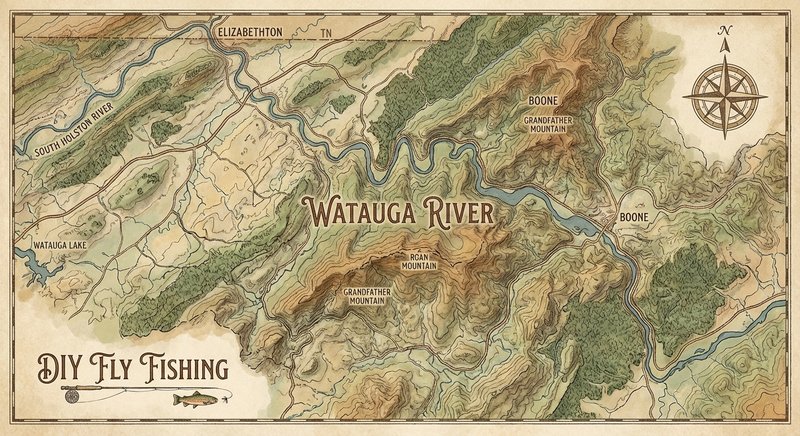
Watauga River
Fly fishing in North Carolina · Beginner · Best seasons: Spring, Summer, Fall
Target Species
Brown Trout, Rainbow Trout
About This Water
High country river with excellent trout fishing. Beautiful mountain scenery near Boone.
Fishing Recommendations
Welcome to the high country of North Carolina. As a guide in this region, I can tell you that while the Watauga River is world-famous for its tailwater section in Tennessee, the Upper Watauga in North Carolina is a freestone gem that offers a completely different, more intimate mountain experience.
Here is your comprehensive guide to fly fishing the Watauga River, NC.
🎣 Location Overview
The North Carolina section of the Watauga River begins high on the slopes of Grandfather Mountain. Unlike the massive, dam-controlled tailwater downstream in Tennessee, the NC Watauga is a classic Appalachian freestone river.
It transitions from a high-gradient, boulder-choked stream in its headwaters (near Foscoe) to a wider, meandering valley river as it flows through the pastoral landscape of Valle Crucis and Sugar Grove. Anglers love this water because it offers a "choose your own adventure" experience: you can tight-line nymph through technical pocket water in the morning and cast dry flies to rising fish in slow, glassy pools in the evening.
🐟 Target Species & Behavior
- Rainbow Trout: These are the primary residents, especially in the "Delayed Harvest" sections. They are generally aggressive and will hold in the faster "bubble lines" and riffles. They are prone to looking up for dry flies once the water hits 50°F.
- Brown Trout: The Watauga holds some surprisingly large wild Brown Trout, along with stocked fish. The big "alphas" are nocturnal and predatory. They hold in deep undercut banks, under large boulders, or in the dark shadows of the rhododendron-lined banks.
- Behavior: Because this is a freestone river, the fish are highly dependent on water temperature and bug activity. In the spring and fall, they are active throughout the day. In the heat of summer, they retreat to the deepest, oxygenated oxygen-rich riffles.
📅 Best Times to Fish
- Spring (March – May): The Prime Window. This coincides with the "Delayed Harvest" season and the most prolific aquatic insect hatches (Quill Gordons, Hendricksons, and March Browns).
- Summer (June – August): Focus on the early mornings and late evenings. The upper headwaters (higher elevation) stay cooler. This is "Terrestrial Season"—think beetles and ants.
- Fall (October – November): Another peak window. The NC Wildlife Resources Commission restocks the Delayed Harvest sections in October. The Brown Trout also become aggressive as they prepare for the spawn (please stay off the "redds" or spawning beds).
- Best Time of Day: During Spring/Fall, 10:00 AM to 4:00 PM is best. In Summer, be on the water at daybreak or during the "Blue Hour" at dusk.
🪰 Recommended Flies & Techniques
Top Fly Patterns
- Nymphs:
- Pat’s Rubber Legs (Coffee/Black, sizes 8-12) – A staple for the Watauga.
- Frenchie or Pheasant Tail (sizes 14-18) – Great for mimicking general mayfly nymphs.
- Sexy Walt’s Worm – Deadly in the Delayed Harvest sections.
- Dry Flies:
- Yellow Sally (size 14-16) – A must-have in late May/June.
- Parachute Adams (sizes 14-20) – The ultimate searcher pattern.
- Elk Hair Caddis (Tan or Olive, sizes 14-16).
- Streamers:
- Black or Olive Woolly Bugger (size 8-10) – Especially after a rain when the water has some "color" to it.
Techniques
- Euro Nymphing (Tight-Line): This is the most effective way to fish the Watauga’s pocket water. Use a long 10ft or 11ft rod to maintain contact with your flies through the turbulent seams.
- Dry-Dropper: Perfect for the riffle-run-pool sequences in Valle Crucis. Use a buoyant Stimulator or Foam Hopper as your "indicator" and hang a small beaded nymph 18-24 inches below it.
- The "Slow Swing": If you see fish rising but can’t get a take, try swinging a small soft-hackle wet fly just below the surface.
💡 Pro Tips & Local Knowledge
- Valle Crucis Community Park: This is the most popular access point. To escape the crowds, walk as far upstream or downstream as possible. The fish near the bridge see a lot of flies; use thinner 6X fluorocarbon tippet here to increase your hook-up rate.
- The "Hatch" Timing: The Yellow Sally hatch in late Spring is legendary on the Watauga. If you see small yellow stones fluttering, put on a yellow dry fly immediately.
- Stealth Matters: The Watauga can get very clear. Avoid wearing bright colors. Use the boulders as cover and move slowly to avoid sending ripples upstream that alert the fish.
- Watch the Gauge: Use the "Watauga River near Sugar Grove" USGS gauge. Ideal flows for wading are generally between 150 and 300 cfs. If it’s over 500 cfs, it can be dangerous to wade.
⚠️ Important Information
- Access: Key access points include:
- Valle Crucis Community Park (Public)
- Guy Ford Road Bridge (Popular for the wilder, lower section)
- Hwy 105 roadside (Foscoe area—look for NCWRC public access signs).
- Regulations: Much of the Watauga is Delayed Harvest (DH).
- From Oct 1 until the first Saturday in June: Catch and Release only, single-hook artificial lures only.
- After the first Saturday in June: It opens to harvest and bait fishing. Check the NCWRC website for specific boundary maps.
- Permit: You must have a valid North Carolina Inland Fishing License. A "Trout Privilege" is required for fishing designated trout waters.
- Private Property: Be respectful. Many sections of the Watauga are bordered by private farmland. Stay in the riverbed and use designated public entry points.
Tight lines! The Watauga is a special place—treat the fish with care, and they'll keep coming back for years to come.
Bug Hatches & Matching Flies
| Hatch | Type | Peak months | Time of day | Hook sizes | Matching flies |
|---|---|---|---|---|---|
| Blue Winged Olives (BWO) Baetis / Drunella | mayfly | March, April, October, November | Late Morning/Afternoon | #18-22 | RS2 #18-22, Parachute Adams #18-22, Pheasant Tail #18-20 |
| Sulphurs Ephemerella invaria / dorothea | mayfly | May, June, July | Late Afternoon/Evening | #14-18 | Sulphur Parachute #14-18, Split Case Sulphur #16-18, Sulphur Cripple #16 |
| Little Black Caddis (Grannom) Brachycentrus | caddis | April | Mid-day/Afternoon | #14-16 | Elk Hair Caddis (Black) #14-16, Peacock Caddis Larva #14-16, Holy Grail #14-16 |
| Quill Gordon Epeorus pleuralis | mayfly | March, April | Mid-day | #12-14 | Quill Gordon #12-14, Guide's Choice Hare's Ear #12-14 |
| Yellow Sallies Isoperla | stonefly | June, July | Late Afternoon | #14-16 | Yellow Stimulator #14-16, Iron Lotus #14-16 |
| Midges Chironomidae | midge | January, February, December | All Day | #18-24 | Zebra Midge #18-22, Griffith's Gnat #20-22, Top Secret Midge #20-22 |
| Light Cahill Stenacron / Stenonema | mayfly | June, July, August | Evening | #12-16 | Light Cahill #12-16, Hare's Ear (Light) #14-16 |
| March Brown Maccaffertium vicarium | mayfly | April, May | Afternoon | #10-14 | March Brown American #12-14, Gold Ribbed Hare's Ear #10-12 |
| Terrestrials (Ants/Beetles) Formicidae / Coleoptera | terrestrial | July, August, September | All Day | #12-18 | Chernobyl Ant #10-14, Black Foam Beetle #14-16, Cinnamon Ant #16-18 |