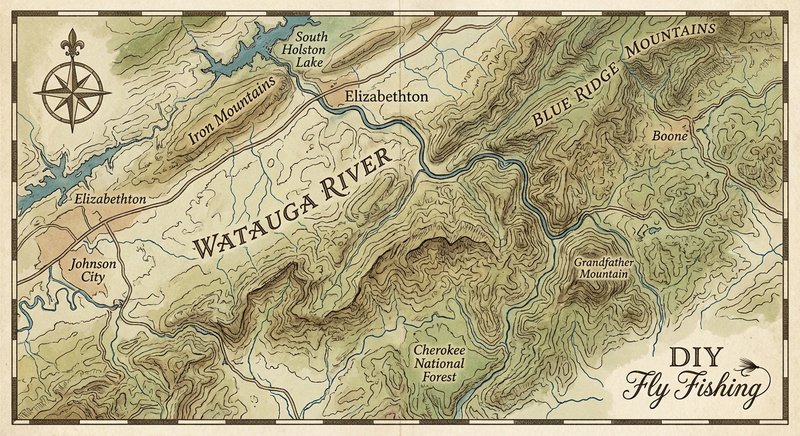
Watauga River
Fly fishing in Tennessee · Beginner · Best seasons: Spring, Summer, Fall, Winter
Target Species
Brown Trout, Rainbow Trout
About This Water
Northeast Tennessee tailwater below Wilbur Dam. Quality trout fishing with good access.
Fishing Recommendations
The Watauga River in Northeast Tennessee is widely considered one of the premier tailwater fisheries in the Southeast. Fed by the bottom-release Wilbur Dam, it offers consistent, cold water temperatures year-round, creating a "trout factory" environment that supports incredible growth rates and dense fish populations.
🎣 Location Overview
The Watauga flows through the scenic Appalachian foothills near Elizabethton, TN. What makes it special is its consistency. While other rivers might get too warm in the summer or freeze in the winter, the Watauga stays in the 45–55°F range almost all year.
The river is characterized by a mix of wide, shallow riffles, deep limestone ledges, and long, glassy pools. It is divided into two distinct experiences: the Quality Trout Zone (Upper River) and the lower sections that meander through farmland. Whether you are wading near the dam or drifting in a McKenzie-style boat, the Watauga provides a high-quality "Western-style" fly fishing experience in the heart of the South.
🐟 Target Species & Behavior
- Rainbow Trout: These are the "workhorses" of the river. They are notoriously hard-fighting, often aerial, and congregate in oxygenated riffles and the heads of pools. They are opportunistic feeders but can become selective during the heavy Sulphur hatches.
- Brown Trout: The Watauga is famous for its trophy "wild" Brown Trout. These fish are more predatory and wary. They tend to hold near undercut banks, submerged logs, and deep ledge transitions. During high water or low light, they become aggressive hunters, often targeting sculpins or smaller trout.
📅 Best Times to Fish
The Watauga is a true 365-day fishery, but each season offers a different "main event":
- Spring (March – May): This is the time for the Grannom Caddis hatch (late March/April). It can be some of the most intense dry fly fishing of the year.
- Summer (June – August): Famous for the Sulphur hatch. On hot afternoons, the cold river creates a "fog" over the water, and thousands of yellow mayflies emerge. This is prime time for dry fly enthusiasts.
- Fall (September – November): As crowds thin, the Blue Winged Olives (BWO) become more prominent. This is also when the big Browns begin to get aggressive moving toward their spawn (please avoid fishing to fish on active spawning redds).
- Winter (December – February): Consistent water temps mean fish stay active. Focus on Midges and Streamers. This is often when the biggest fish of the year are caught on large articulated flies.
Prime Window: Late afternoon through dusk during the summer Sulphur hatch is the "Golden Hour" on the Watauga.
🪰 Recommended Flies & Techniques
Nymphing (The Bread & Butter)
Nymphing accounts for 80% of the fish caught here. Use a two-fly rig under an indicator or a "Euro" (tight-line) setup.
- Patterns: Zebra Midges (#18-22 in red or silver), Pheasant Tails (#16-20), Frenchies, and the Ruby Slipper.
- The "Watauga Rig": Many locals use a small "Jig" style nymph as the dropper to avoid snagging the rocky bottom.
Dry Fly (The Purist’s Choice)
When the hatch is on, the Watauga becomes a world-class dry fly river.
- Patterns: Sparkle Duns (Sulphur), Elk Hair Caddis (Tan/Olive), Parachute Adams, and CDC BWO.
- Tip: Use long, 12-foot leaders tapered to 6X or 7X fluorocarbon for the glassy pools.
Streamers (For the Trophies)
When the TVA (Tennessee Valley Authority) is pulsing water for power generation, it’s time to throw the big stuff.
- Patterns: Kelly Galloup’s Dungeon, Sex Dungeon, Sparkle Minnows, and Black/Olive Wooly Buggers.
- Technique: Fish these on a sink-tip line, pounding the banks and stripping back quickly.
💡 Pro Tips & Local Knowledge
- The "Quality Zone": Focus your efforts on the 2.5-mile stretch from Wilbur Dam down to Blevins Creek. This is a "Trophy Section" with special regulations, resulting in a much higher concentration of large fish.
- The TVA App: This is your most important tool. You must check the Wilbur Dam release schedule on the TVA Lake Info app. If they turn on two generators, the river becomes dangerous to wade and is strictly for drift boats.
- The "Sulphur Fog": In the summer, the air is hot and the water is cold, creating a thick mist. The fish feel protected by this cover and will often rise in very shallow water. Move slowly and look for "sips" right against the bank.
- Micro-Midges: When nothing seems to be hatching but fish are rising, they are likely eating "spent" midges or "shuck" clusters. Downsize your fly to a #24 and your tippet to 7X.
⚠️ Important Information
Access Points
- Wilbur Dam: Great wading access right at the top.
- Siam Bridge: Popular mid-river access.
- Hunter Bridge: Good wading access with several large pools.
- Sycamore Shoals State Park: Lower river access, great for rainbows and the occasional smallmouth.
Regulations & Permits
- License: A Tennessee Fishing License with a Trout Hatchery Supplement is required.
- Quality Trout Zone: In this specific section (Wilbur Dam to Blevins Creek), only artificial lures are allowed, and there is a protected length range (slot limit). Most anglers here practice 100% Catch and Release.
- Safety: The Watauga is a tailwater. When the sirens sound at the dam, the water rises rapidly (several feet in minutes). If you see the water start to get muddy or see sticks floating by, get to the bank immediately.
Local Ethics
The Watauga gets busy. If a boat is drifting through, waders should give them the channel; if you are in a boat, give waders a wide berth and don't "low-hole" (drop in right downstream) of someone already fishing a run.
Tight lines! The Watauga is a rewarding river that punishes poor presentations but deeply rewards technical skill.
Bug Hatches & Matching Flies
| Hatch | Type | Peak months | Time of day | Hook sizes | Matching flies |
|---|---|---|---|---|---|
| Blue Winged Olives (BWO) Baetis | mayfly | March, April, October, November | Late Morning/Afternoon | #18-22 | RS2 #18-22, Parachute Adams #18-22, Pheasant Tail #18-20 |
| Sulphurs Ephemerella dorothea | mayfly | May, June, July | Late Afternoon/Evening | #14-18 | Sulphur Parachute #14-18, Split Case Sulphur #16-18, Sulphur CDC Emerger #16-18 |
| Tan Caddis Hydropsyche | caddis | April, May, June | All Day/Evening | #14-18 | Elk Hair Caddis #14-16, Holy Grail #14-18, Pupa-Zilla #16 |
| Midges Chironomidae | midge | January, February, December | All Day | #18-24 | Zebra Midge #18-22, Griffith's Gnat #20-22, Morgan's Midge #20-24 |
| Black Caddis (Grannom) Brachycentrus | caddis | April | Mid-day/Afternoon | #14-16 | Black Elk Hair Caddis #14-16, Deep Blue Poison Tung #16 |
| Blue Quill Paraleptophlebia | mayfly | March, April | Mid-day | #16-18 | Blue Quill Dry #16-18, Frenchie #16-18 |
| Terrestrials (Beetles/Ants) Coleoptera/Formicidae | terrestrial | July, August, September | All Day | #12-18 | Foam Beetle #12-16, Cinnamon Ant #16-18, Morrish Hopper #10-14 |
| Crane Flies Tipulidae | midge | August, September, October | Morning/Evening | #8-12 | Daddy Long Legs #10-12, Crane Fly Larva #8-12 |