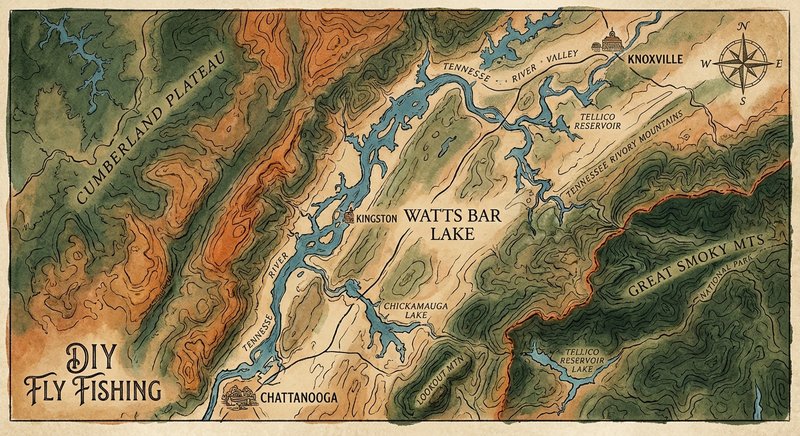
Watts Bar Lake
Fly fishing in Tennessee · Beginner · Best seasons: Spring, Summer, Fall
Target Species
Largemouth Bass, Sauger, Catfish
About This Water
Large TVA reservoir with diverse fishery. Bass, sauger, and catfish.
Fishing Recommendations
Watts Bar Lake is a massive, diverse reservoir on the Tennessee River, nestled between Knoxville and Chattanooga. While many associate these waters with heavy-duty gear and bass boats, Watts Bar is a sleeper hit for the fly angler who understands current, structure, and the "river-lake" hybrid nature of the Tennessee River Valley Authority (TVA) system.
🎣 Location Overview
Watts Bar Lake covers over 38,000 acres and stretches 72 miles from Fort Loudoun Dam to Watts Bar Dam. What makes it special is its diversity of habitat. You have high-gradient riverine sections in the upper reaches, deep rocky bluffs in the mid-lake, and expansive, shallow flats and embayments in the lower section.
The water characteristics are dictated by the TVA (Tennessee Valley Authority). This is a "run-of-the-river" reservoir, meaning current is the primary driver of fish activity. When the dams are "pulling water," the fish turn on. For the fly angler, the mix of submerged timber, rip-rap banks, and massive shad schools creates a dynamic environment that mimics both a slow-moving river and a deep-water lake.
🐟 Target Species & Behavior
Largemouth Bass
- Behavior: In spring, they move into the "hollows" (creek arms) to spawn. In summer and fall, they orient toward "points," submerged ledges, and boat docks.
- Feeding: Their diet is 90% Gizzard and Threadfin Shad, though they won't pass up a crayfish or a bluegill.
Sauger
- Behavior: These are the "cool-water cousins" of the Walleye. They are light-sensitive and stay deep during the day, moving shallower at dusk. They love current and are almost always found near the bottom.
- Feeding: Highly predatory. They focus exclusively on small minnows and shad.
Catfish (Channel and Blue)
- Behavior: While often ignored by fly anglers, Watts Bar has a massive population of Channel Cats that act surprisingly like predators in the current. They hold behind rocks or submerged logs, waiting for food to be swept by.
- Feeding: They respond well to "scent-heavy" or vibration-heavy flies that mimic crawfish or dying baitfish.
📅 Best Times to Fish
- Spring (March – May): Prime Time. As water temps hit 55°F, Largemouth move shallow. This is the best window for fly fishing as fish are within reach of floating lines. Sauger are stacked below the Fort Loudoun Dam in the tailwaters.
- Summer (June – August): Best for low-light conditions. Fish the "creek mouths" early in the morning with topwater flies. Mid-day is tough unless you have a heavy sinking line to reach the 15–20 foot thermocline.
- Fall (September – November): The Shad Migration. As water cools, shad move into the backs of creeks. Bass follow them in a feeding frenzy. This is the best time for "match the hatch" baitfish patterns.
- Optimal Window: Always check the TVA Lake Info App. You want to fish when they are discharging water (generating power). Current acts as a dinner bell.
🪰 Recommended Flies & Techniques
For Largemouth Bass
- Topwater: Dahlberg Divers or Bob’s Banger (White/Silver). Fish these against dock pilings and "laydowns" (fallen trees).
- Sub-Surface: Gamechangers (3.5 to 5 inches) in shad patterns. These have the articulation to mimic a dying shad perfectly.
- Technique: Use an 8-weight rod with a weight-forward floating line. Target the "shadow line" of boat docks.
For Sauger
- Patterns: Clouser Minnows (Chartreuse/White or Orange/Gold) with heavy dumbbell eyes.
- Technique: You must get to the bottom. Use a 250–300 grain sinking tip. Cast upstream into the current, let it sink until you feel the bottom, and use short, erratic strips. It’s "nymphing" with a streamer.
For Catfish
- Patterns: Heavy Lead-Eyed Woolly Buggers (Black or Olive) or Whitlock’s Near Nuff Craw.
- Technique: Look for "rip-rap" (rocky) banks near current. Dead-drift the fly along the bottom like you would for a trout, or use a slow "drag and hop" retrieve.
💡 Pro Tips & Local Knowledge
- The "Bubble Line": When the dams are pulling water, look for foam or bubble lines forming in the main channel. This indicates a current seam. Predators sit right under that foam to intercept disoriented baitfish.
- Focus on the "Tennessee River Side": The Clinch River and the Tennessee River merge at Watts Bar. The Tennessee side usually has more color (stain), which is better for fly fishing because the fish are less "spooky" in shallow water.
- Night Fishing: During the heat of summer, the biggest Largemouth and Catfish are caught at night. Use large, black, silhouette-heavy flies (like a Black Gurgler) to create a vibration on the surface.
- The Mud Line: After a heavy rain, find where a clear creek enters the stained main lake. Fish the "mixing zone." Bass will hide in the mud and strike into the clear water.
⚠️ Important Information
- Access: There are numerous public boat ramps (e.g., Thief Neck, Kingston City Park). A boat or kayak is highly recommended; bank access is limited due to private property and steep bluffs.
- Regulations: You need a standard Tennessee Freshwater Fishing License. Note that Sauger have specific size and creel limits (usually 15 inches, 10 fish per day, but check current TWRA proclamations as they change).
- Safety: Watts Bar is a commercial waterway. Watch out for barges in the main channel; they cannot stop quickly and create massive wakes. Always wear a PFD, especially when fishing near the dams where water levels can rise several feet in minutes.
Guide’s Final Word: Watts Bar is a "workhorse" lake. It’s not always pretty, but it is incredibly productive. If you master the art of the sinking line and learn the TVA discharge schedule, you will find some of the best warm-water fly fishing in the Southeast.
Bug Hatches & Matching Flies
| Hatch | Type | Peak months | Time of day | Hook sizes | Matching flies |
|---|---|---|---|---|---|
| Giant Yellow Mayfly (Hex) Hexagenia limbata | mayfly | June, July | Dusk/Night | #6-10 | Hexagenia Dry #6-8, Burrowing Nymph #8-10 |
| Midges Chironomidae | midge | February, March, November | All Day | #18-24 | Zebra Midge #18-22, Griffith's Gnat #20-22 |
| Damselfly Enallagma spp. | other | May, June, July | Morning/Afternoon | #10-14 | Adult Damselfly #10-12, Marabou Damsel Nymph #12-14 |
| White Mayfly Ephoron leukon | mayfly | August, September | Evening | #12-14 | White Wulff #12-14, White Miller #14 |
| Annual Cicada Neotibicen canicularis | terrestrial | July, August | Afternoon | #4-8 | Cicada Pattern #4-8, Fat Albert #6-10 |
| Cinnamon Caddis Hydropsyche spp. | caddis | May, June, September | Evening | #14-18 | Elk Hair Caddis #14-16, Soft Hackle #16 |
| Trico Tricorythodes spp. | mayfly | July, August, September | Morning | #20-24 | Trico Spinner #22-24, Trico Duns #20-22 |
| Dragonfly Anisoptera | other | June, July | All Day | #4-10 | Dragonfly Nymph #6-10, Deer Hair Dragonfly #4-8 |