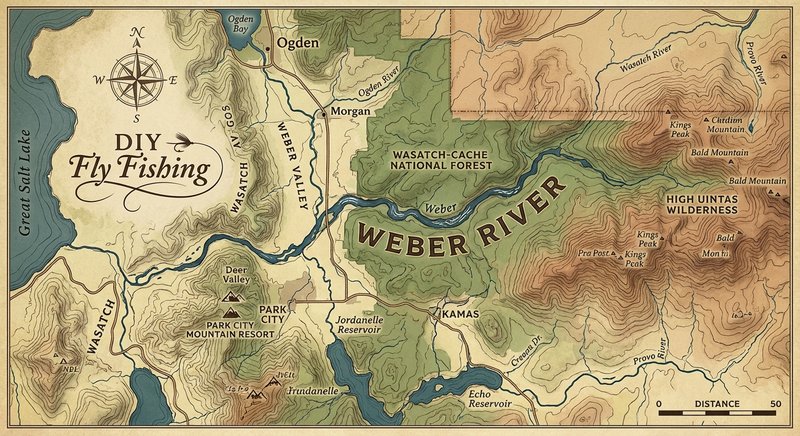
Weber River
Fly fishing in Utah · Beginner · Best seasons: Spring, Summer, Fall
Target Species
Brown Trout, Rainbow Trout
About This Water
Excellent brown trout fishery near Ogden. Good access and consistent fishing.
Fishing Recommendations
Tight lines! As your guide for the day, let’s dive into one of Northern Utah’s most productive—and sometimes most technical—fisheries: The Weber River.
Affectionately known by locals as "The Weber" (pronounced wee-ber), this river is a tailwater gem that offers everything from high-country meadow fishing to deep canyon pockets.
🎣 Location Overview
The Weber River is a diverse fishery stretching from the high Uinta Mountains down to the Great Salt Lake. However, for the serious fly angler, the "meat" of the river lies in two primary sections:
- The Middle Weber: Flowing between Rockport and Echo Reservoirs. This is a classic tailwater section characterized by braided channels, riffles, and deep bends.
- The Lower Weber: Flowing from Echo Reservoir through Henefer and down into Weber Canyon. This section is faster, deeper, and holds some of the river's largest fish.
What makes it special: The Weber is famous for its sowbug population. Unlike many freestone rivers, the Weber's tailwater sections are nutrient-rich, supporting a massive biomass of crustaceans. It’s a river that requires a "technical eye" but rewards you with high fish counts and beautiful, buttery Brown Trout.
🐟 Target Species & Behavior
- Brown Trout: The kings of the Weber. They range from 10-inch "zippers" to 20-inch+ brutes. They love the undercut banks and the deep "buckets" behind large boulders. In the fall, they become aggressive and territorial.
- Rainbow Trout: Found mostly in the faster riffles and oxygenated water. Many are stocked, but there is a healthy population of wild, hard-fighting rainbows that love to jump.
- Mountain Whitefish: You will catch these. They are native, fight hard, and congregate in the deep winter holes.
Feeding Behavior: Weber trout are "bottom feeders" by necessity. Because of the sowbug and midge density, they often hold tight to the substrate. However, during a PMD or Caddis hatch, they will move into the shallow "film" at the tail-outs of pools.
📅 Best Times to Fish
Spring (March - May)
- The Draw: The legendary Mother’s Day Caddis hatch.
- Conditions: High water can occur during runoff (May), but the window just before runoff offers some of the best dry fly fishing of the year.
- Window: 11:00 AM – 4:00 PM.
Summer (June - August)
- The Draw: Yellow Sallies and PMDs (Pale Morning Duns).
- Conditions: Flows stabilize after runoff. This is the prime time for "Hopper-Dropper" rigs along the banks.
- Window: Early morning for nymphs; late evening (7 PM – dusk) for the "Caddis blizzard."
Fall (September - November)
- The Draw: Brown Trout spawn and BWO (Blue Winged Olive) hatches.
- Conditions: Cool, crisp air and low, clear water. This is streamer season for the big Browns.
- Window: The heat of the day (10:00 AM – 3:00 PM) for hatches.
🪰 Recommended Flies & Techniques
The "Weber Special" Nymph Rig
On the Weber, if you aren't hitting the bottom, you aren't fishing.
- Sowbugs: Ray Charles (Grey/Pink), Soft Hackle Sowbugs (#16-20). This is the #1 producer year-round.
- Midges: Zebra Midges (Black, Red, or Olive) #18-22.
- Mayflies: Juju Baetis, RS2s, and Pheasant Tails.
Dry Flies
- Caddis: Elk Hair Caddis (Tan/Peacock) #14-18.
- Mayflies: Parachute Adams, CDC PMDs #16-20.
- Terrestrials: Fat Alberts or Chernobyl Ants in late summer.
Streamers
- Patterns: Gold-beaded Wooly Buggers (Olive or Black), Sculpzilla, or Sex Dungeon (for the Lower Weber).
- Technique: Swing streamers through deep runs or "strip-and-pause" near undercut banks.
💡 Pro Tips & Local Knowledge
- Bounce the Bottom: Use more split shot than you think you need. The Weber's current is deceptively heavy. If you aren't ticking the rocks occasionally, you are fishing over the fish's heads.
- The "Henefer to Taggart" Float: If you have a drift boat or raft, this section of the Lower Weber is iconic. It’s scenic and allows access to water that bank anglers can’t reach.
- The Sowbug Secret: Even during a visible hatch, the fish often prefer the nymph. Try a "Dry-Dropper" with a high-vis dry fly and a weighted sowbug 2 feet underneath.
- Mind the Braids: In the Middle Weber (near Henefer), the river splits into small channels. Don't walk past these! Big fish hide in 12 inches of water in these side braids to escape the main current.
⚠️ Important Information
- Access: Much of the Weber runs through private land. Use the DWR Walk-In Access (WIA) points. Respect fences and stay within the high-water mark.
- Regulations:
- Middle Weber (Rockport to Echo): Check current proclamations. Often restricted to artificial flies and lures only with specific bag limits.
- Lower Weber: Generally more open, but always verify the Utah Fishing Guidebook for seasonal closures near spawning beds.
- Safety: The Weber has several diversion dams. If floating, know exactly where they are (especially the one near Morgan/Taggart). They can be lethal to boaters.
- Permit: A valid Utah Fishing License is required.
Guide’s Final Word: The Weber is a "blue-collar" river. It’s not always crystal clear or easy to wade, but if you master the sowbug drift, you’ll have 30-fish days that you'll remember for a lifetime. Tight lines!
Bug Hatches & Matching Flies
| Hatch | Type | Peak months | Time of day | Hook sizes | Matching flies |
|---|---|---|---|---|---|
| Midges Chironomidae | midge | January, February, March, December | Late Morning/Afternoon | #18-24 | Zebra Midge #18-22, Griffith's Gnat #20-24, Mother's Day Midge #20-22 |
| Blue Winged Olive (BWO) Baetis | mayfly | March, April, October, November | Late Morning/Afternoon | #18-22 | RS2 #18-22, Parachute Adams #18-22, JujuBaetis #18-20 |
| Mother's Day Caddis Brachycentrus occidentalis | caddis | May | Mid-day/Evening | #14-16 | Elk Hair Caddis #14-16, Peeping Caddis #14-16, LaFontaine's Deep Sparkle Pupa #14-16 |
| Pale Morning Dun (PMD) Ephemerella excrucians | mayfly | June, July, August | Morning/Early Afternoon | #16-18 | PMD Cripple #16-18, Pheasant Tail #16-18, Split Case PMD #16-18 |
| Golden Stonefly Hesperoperla pacifica | stonefly | June, July | All Day/Evening | #8-12 | Pat's Rubber Legs #8-12, Chubby Chernobyl #8-12, Stimulator (Yellow/Gold) #10-12 |
| Yellow Sally Isoperla | stonefly | June, July, August | Afternoon/Evening | #14-16 | Yellow Sally Foam Run #14-16, Iron Lotus #14-16, Kush's Yellow Sally #14-16 |
| Trico Tricorythodes | mayfly | August, September | Early Morning | #20-24 | Trico Spinner #22-24, Sunken Trico Spinner #20-22, CDC Trico #22-24 |
| Terrestrials Orthoptera / Formicidae | terrestrial | July, August, September | Mid-day/Afternoon | #10-16 | Morrish Hopper #10-14, Black Foam Ant #14-18, Galloup's Ant Acid #14-16 |