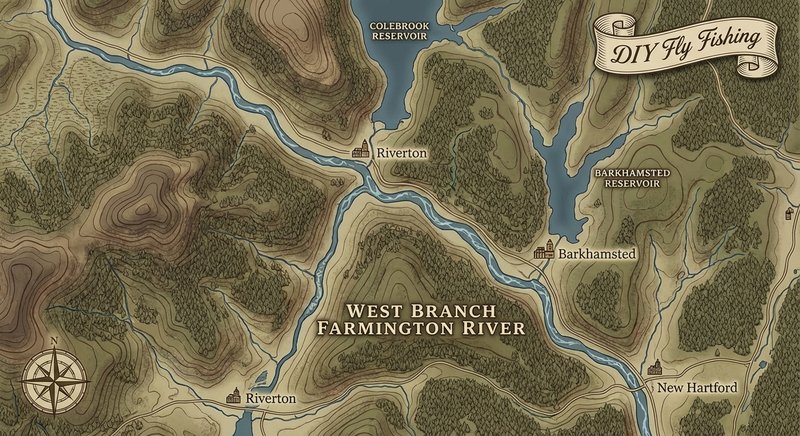
West Branch Farmington
Fly fishing in Connecticut · Intermediate · Best seasons: Spring, Summer, Fall
Target Species
Brook Trout, Brown Trout
About This Water
Upper Farmington section with wild brook trout. Mountain stream character.
Fishing Recommendations
Hello there! It’s a pleasure to guide you through one of the crown jewels of Northeast fly fishing. The West Branch Farmington River in Connecticut is widely considered the finest trout stream in Southern New England. It is a tailwater fishery, meaning the water is released from the bottom of the Goodwin Dam (Hogback), providing cold, consistent flows year-round.
Here is your comprehensive guide to tackling the West Branch Farmington.
🎣 Location Overview
The West Branch of the Farmington is a "blue ribbon" tailwater that runs through the picturesque towns of Riverton, Pleasant Valley, and New Hartford. What makes it special is the Year-Round Catch and Release (C&R) area, which encompasses several miles of prime water.
Because the water comes from the bottom of a deep reservoir, it stays cold (low 50s°F) even in the heat of August, making it a sanctuary for trout when other rivers are too warm to fish. The river characteristics vary from classic "pool and drop" water to long, glassy flats and heavy pocket water. It is a highly technical river with a massive biomass of insects, leading to some of the most consistent hatches in the country.
🐟 Target Species & Behavior
The Farmington is home to Wild Brown Trout, Wild Brook Trout, and heavy stockings of retired broodstock and "Survivor" strain Browns.
- Brown Trout: These are the kings of the river. They are notorious for being "leader shy" and highly selective. In the technical flats, they will hold just beneath the surface, sipping tiny midges or olives. In heavier water, they tuck behind boulders or deep in the "seams" between fast and slow water.
- Brook Trout: While less common than Browns in the main stem, wild Brookies thrive in the upper reaches near Riverton and in the cold-water tributaries. They are opportunistic but cautious.
- Behavior: Due to heavy fishing pressure, these fish are "educated." They know what a bad drift looks like. Precision and stealth are more important here than anywhere else in the region.
📅 Best Times to Fish
The Farmington is a 365-day fishery, but here are the prime windows:
- Spring (April – June): This is the "Main Event." Water levels stabilize, and the major hatches begin.
- Key Window: Mid-day to evening.
- Summer (July – August): While other rivers are closed due to heat, the Farmington shines. The fish are active, but the water is often low and clear.
- Key Window: Early morning for Tricos; late evening for the legendary "Ant" falls and Cahills.
- Fall (September – November): My personal favorite. The Brown trout move into their pre-spawn colors and become more aggressive. The foliage is world-class.
- Key Window: 10:00 AM to 4:00 PM.
- Optimal Conditions: A steady or slightly dropping flow (between 150 and 400 CFS) is ideal for wading. Check the USGS gauge at Riverton before heading out.
🪰 Recommended Flies & Techniques
Top Fly Patterns
- Dry Flies:
- Blue Winged Olives (BWO): Sizes 18–24 (Year-round).
- Hendricksons: Sizes 12–14 (Late April/May).
- Tricos: Sizes 22–26 (July/August mornings).
- Winter Caddis: Sizes 18–22 (January–March).
- Terrestrials: Flying Ant (Size 18) and Fur Ants are lethal in late summer.
- Nymphs:
- Pats Rubber Legs: Size 8–12 (Great for high water/searching).
- Perdigons/Euro Jigs: Size 14–18 in silver or copper.
- Frenchies/Pheasant Tails: Size 16–20.
- Streamers:
- Wooly Buggers: Black or Olive.
- Sculpin Patterns: Articulated streamers in the deeper pools during low-light conditions.
Techniques
- Euro Nymphing: This is arguably the most effective way to catch fish here. Using long rods and thin leaders to maintain direct contact with nymphs in the pocket water is a local staple.
- Dry-Dropper: Excellent for the riffles. Use a high-vis Chubby Chernobyl or a Foam Caddis with a small unweighted pheasant tail behind it.
- The "Micro-Midge" Drift: On the flat pools, use 6x or 7x fluorocarbon tippet and a single size 22 midge. You must achieve a dead drift; any micro-drag will result in a refusal.
💡 Pro Tips & Local Knowledge
- The "Trico" Trick: In August, the Trico hatch can be frustrating. Look for the "spinner fall" (when the bugs die and hit the water) around 9:00 AM. Use a double-dry rig: a visible size 16 dry fly as a "sighter," and a tiny size 24 Trico spinner tied 18 inches behind it.
- Stealth is Key: Because the water is often crystal clear, don't just march into the river. Stand 10 feet back from the bank and observe for 5 minutes. You'll often see big fish holding in just 12 inches of water right at your feet.
- Stretches to Focus On:
- The Church Pool: Iconic, but crowded. Great for hatches.
- The Greenwoods Area: Excellent pocket water for nymphing.
- People’s State Forest: Beautiful scenery and plenty of room to spread out.
- The "Ant" Secret: On windy late-summer afternoons, trout look specifically for ants falling from the overhanging trees. A size 18 Cinnamon Ant is often more effective than any hatch occurring at the time.
⚠️ Important Information
- Regulations: The section from the Goodwin Dam down to the Route 219 bridge in New Hartford is a Year-Round Catch and Release area. Barbless hooks are highly encouraged (and required in some specific zones—always check the current CT DEEP Angler’s Guide).
- Permits: You need a Connecticut Fishing License and a Trout & Salmon Stamp. These can be purchased online via the CT DEEP website.
- Safety: The rocks in the Farmington are notoriously slippery (known as "Farmington Grease"). Studded wading boots and a wading staff are non-negotiable if you value your tailbone.
- Flows: The dam can release water at any time. If you notice the water rising or getting muddy, exit the river immediately. Use the "Savin Rock" USGS gauge for the most accurate readings.
Tight lines, and enjoy the beauty of the Farmington! It’s a challenging river, but landing a 20-inch wild Brown here is a badge of honor for any fly fisher.
Bug Hatches & Matching Flies
| Hatch | Type | Peak months | Time of day | Hook sizes | Matching flies |
|---|---|---|---|---|---|
| Blue-Winged Olive (BWO) Baetis & Acerpenna | mayfly | April, May, September, October | Late Morning/Afternoon | #18-24 | RS2 #20-24, Parachute BWO #18-22, Pheasant Tail #18-20 |
| Hendrickson Ephemerella subvariabilis | mayfly | April, May | Afternoon | #12-14 | Red Quill #12-14, Hendrickson Emerger #12-14, Gold Ribbed Hare's Ear #12-14 |
| Sulfur Ephemerella dorothea & invaria | mayfly | June, July | Evening | #16-20 | Sulfur Parachute #16-18, Sulfur Spinner #16-20, CDC Sulfur Emerger #16-18 |
| Trico Tricorythodes | mayfly | July, August, September | Early Morning | #22-26 | Trico Spinner #22-26, Sunken Trico Spinner #24-26, Griffith's Gnat #20-24 |
| Winter Caddis Dolophilodes | caddis | January, February, March | Late Morning | #18-22 | Zebra Midge #18-22, CDC Winter Caddis Adult #18-20, Pupa Imitation #18-22 |
| Isonychia (Slate Drake) Isonychia bicolor | mayfly | June, August, September | Late Afternoon/Evening | #10-12 | Iso Parachute #10-12, Prince Nymph #10-12, Zug Bug #10-14 |
| Chimarra (Little Black Caddis) Chimarra aterrima | caddis | May, June | Morning/Evening | #18-20 | CDC Black Elk Hair Caddis #18-20, Black Peacock Caddis #18-20, Green Weenie (Caddis Larva) #16-18 |
| Light Cahill Stenacron canadense | mayfly | June, July | Evening | #12-14 | Light Cahill #12-14, Cream Usual #12-14, Light Cahill Spinner #12-14 |
| Common Midge Chironomidae | midge | January, February, March, December | All Day | #20-28 | Griffith's Gnat #20-24, Bling Midge #22-26, Morgan's Midge #20-24 |
| Giant Golden Stonefly Acronesuria | stonefly | June, July | Evening/Night | #6-10 | Golden Stone Nymph #6-10, Pat's Rubber Legs #8-12, Stimulator (Yellow) #10-12 |