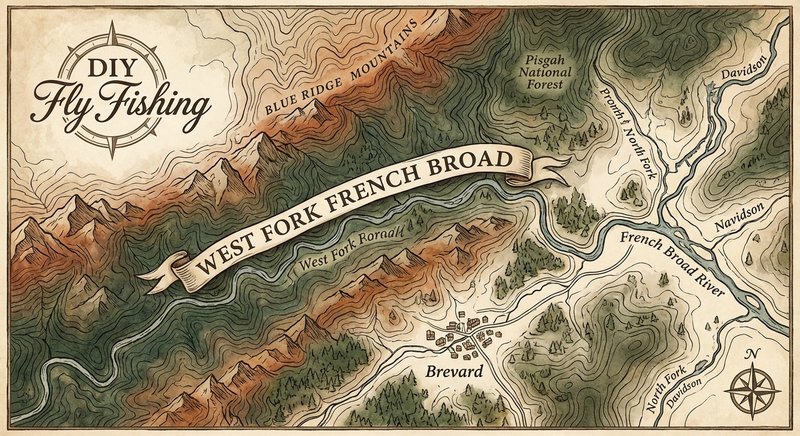
West Fork French Broad
Fly fishing in North Carolina · Intermediate · Best seasons: Spring, Summer, Fall
Target Species
Brown Trout, Rainbow Trout
About This Water
Mountain stream with wild trout. Less pressured than nearby waters.
Fishing Recommendations
The West Fork of the French Broad River is one of Western North Carolina’s most scenic and productive fly fishing destinations. Tucked away in the Pisgah National Forest near the town of Rosman, it offers a quintessential Appalachian freestone experience. Whether you are targeting the aggressive stocked fish in the Delayed Harvest section or hunting wild browns in the headwaters, this river is a must-fish for any serious angler.
🎣 Location Overview
The West Fork is a classic medium-sized freestone stream characterized by its exceptionally clear water, boulder-strewn runs, and plunging waterfalls. It flows through the heart of Transylvania County—the "Land of Waterfalls"—and its scenery is as much of a draw as the fishing.
What makes the West Fork special is its dual personality. The lower section is a Delayed Harvest (DH) reach, which receives heavy stockings of Rainbow, Brown, and Brook trout, making it a high-catch-rate area from fall through early summer. As you move higher up NC-215, the river transitions into a wild trout fishery, where the canopy tightens, the gradients steepen, and the fish become smaller but much more wary.
🐟 Target Species & Behavior
- Rainbow Trout: In the DH section, these are the most common. They tend to hold in the faster "bubble lines" and at the heads of pools. They are opportunistic and will often move several feet to intercept a fly.
- Brown Trout: The West Fork is famous for some truly large "holdover" Browns in the DH section and beautiful wild Browns in the upper reaches. Browns here are structure-oriented; look for them under overhanging rhododendrons, behind large submerged boulders, or in deep undercut banks.
- Feeding Behavior: During hatch cycles (Spring/Fall), fish will rise readily to dries. However, because it is a nutrient-poor freestone stream, these fish spend 90% of their time feeding sub-surface on nymphs and small crawfish.
📅 Best Times to Fish
Optimal Seasons
- Spring (March – May): Prime Time. This is the peak of the DH season. Water temperatures are rising into the 50s, and the major hatches (Quill Gordons, March Browns, Hendrickson’s) occur.
- Summer (June – August): Focus on the upper, high-elevation wild sections. The lower DH water can get too warm for the fish's safety by mid-July. Morning and late evening are the only windows for the lower sections.
- Fall (October – November): The DH season restarts with heavy stockings in October. The fall colors are spectacular, and the Brown trout become aggressive as they prepare for the spawn.
Best Times of Day
- Spring/Fall: 10:00 AM – 4:00 PM (Waiting for the water to warm slightly).
- Summer: 6:00 AM – 10:00 AM (Before the sun hits the water).
🪰 Recommended Flies & Techniques
Top Fly Patterns
- Nymphs: Sexy Walt’s Worm (Size 12-16), Pheasant Tail (Size 14-18), Girdle Bug (Pat’s Rubber Legs) in Black/Tan for the DH fish.
- Dry Flies: Yellow Stimulator (Size 12-14), Parachute Adams (Size 14-18), and Elk Hair Caddis. For summer, use terrestrials like the Fat Albert or Dave’s Hopper.
- Streamers: Woolly Bugger (Olive or Black) and the Game Changer for targeting large holdover Browns in the deep pools.
Techniques & Presentation
- Tight-Line Nymphing: This is the most effective way to fish the West Fork’s pocket water. By eliminating the indicator, you can get your flies deep into the small pockets behind boulders where fish hide.
- Dry-Dropper: A perfect choice for the late spring. Use a buoyant Stimulator as your "indicator" and hang a small beaded Pheasant Tail 18–24 inches below it.
- Stealth: The water is crystal clear. Wear earthy tones (greens/browns), keep a low profile, and always wade upstream to avoid sending silt and shadows toward the fish.
💡 Pro Tips & Local Knowledge
- The "V" and the "Seam": On the West Fork, fish love the seams where fast water meets slow water. Don't just fish the big pools; some of the biggest fish live in "pocket water" no larger than a bathtub.
- The Upper Reaches: If the DH section is crowded (which it can be on weekends), keep driving north on NC-215. The water above the DH section holds beautiful wild trout that rarely see a fly compared to the lower fish.
- The "Balsam Grove" Stretch: This area has excellent public access but gets pressured. Try using smaller, more technical nymphs (Size 18-20) if the fish are "lookers" but not "eaters."
- Summer Terrestrials: If you’re fishing in August, don't overlook an Inchworm pattern. The overhanging rhododendrons often drop these into the water, and trout go crazy for them.
⚠️ Important Information
Access
- Access is primarily along NC-215. There are many pull-offs along the road. Most of the river through the National Forest is public, but always keep an eye out for "Posted" or "Private Property" signs, especially near the lower reaches closer to Rosman.
Regulations & Permits
- Delayed Harvest (DH): From October 1 until the first Saturday in June, the DH section is Catch and Release ONLY and restricted to Single-Hook Artificial Lures ONLY. No bait is allowed.
- Wild Water: Upper sections have different regulations (generally 7-inch minimum, 4-fish limit, but check the NCWRC website for specific boundary markers).
- License: A North Carolina Fishing License with a Trout Privilege is required.
Special Considerations
- Wading Safety: The West Fork is rocky and can be extremely slippery. Felt-soled boots or studded rubber soles are highly recommended.
- Cell Service: Expect zero cell service once you start heading up NC-215. Download your maps or let someone know where you are going before you leave Rosman.
Bug Hatches & Matching Flies
| Hatch | Type | Peak months | Time of day | Hook sizes | Matching flies |
|---|---|---|---|---|---|
| Blue-Winged Olive Baetis / Acerpenna | mayfly | March, April, October, November | Late Morning/Afternoon | #18-22 | BWO Parachute #18-22, RS2 #20-22, Pheasant Tail Nymph #18-20 |
| Quill Gordon Epeorus confusus | mayfly | March, April | Midday | #12-14 | Quill Gordon #12-14, Iron Blue Dun #14, Guide's Choice Hare's Ear #12-14 |
| March Brown Maccaffertium vicarium | mayfly | April, May | Afternoon | #10-14 | March Brown Western #12-14, Gold Ribbed Hare's Ear #10-12, March Brown Wet Fly #12 |
| Yellow Sally Isoperla spp. | stonefly | May, June, July | Late Afternoon/Evening | #14-16 | Yellow Sally Stone #14-16, Little Yellow Sloan #14-16, Stimulator (Yellow) #14-16 |
| Light Cahill Stenacron / Stenonema | mayfly | June, July | Evening | #12-16 | Light Cahill Parachute #12-16, Cream Variant #14, Mercer's Poxyback Cahill #14-16 |
| Cinnamon Caddis Hydropsyche | caddis | May, June, September | Evening | #14-18 | Elk Hair Caddis (Tan) #14-18, Holy Grail #16, Frenchie #14-18 |
| Golden Stonefly Acroneuria carolinensis | stonefly | June, July | Morning/Evening | #8-12 | Golden Stone Nymph #8-12, Kaufmann's Stone #8-10, Madam X #8-12 |
| Terrestrials Formicidae / Coleoptera | terrestrial | July, August, September | All Day | #12-18 | Parachute Ant #16-18, Foam Beetle #14-16, Dave's Hopper #12 |