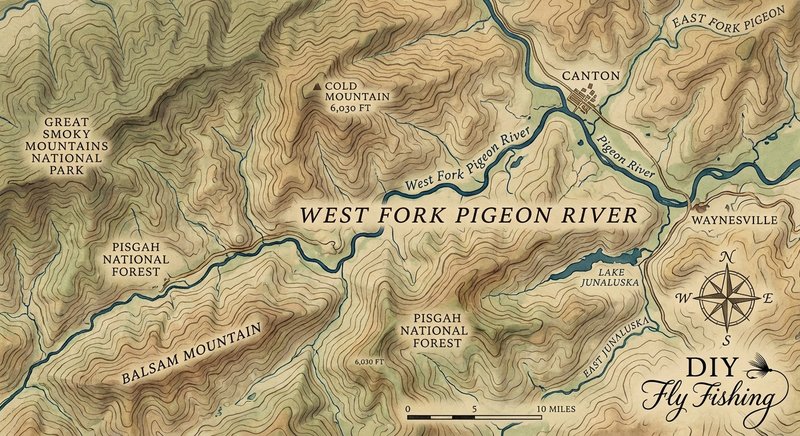
West Fork Pigeon River
Fly fishing in North Carolina · Intermediate · Best seasons: Spring, Summer, Fall
Target Species
Brown Trout, Rainbow Trout
About This Water
Mountain stream near Waynesville with wild trout. Good hatches spring through fall.
Fishing Recommendations
The West Fork of the Pigeon River is a gem of Western North Carolina. Tucked away in Haywood County, south of Waynesville, it offers a quintessential Appalachian fly fishing experience. Whether you are fishing the technical "Delayed Harvest" section or exploring the high-gradient wild water near the headwaters, this river provides both beauty and productivity.
🎣 Location Overview
The West Fork of the Pigeon is a classic freestone mountain river that originates high on the slopes of the Blue Ridge Parkway near the Shining Rock Wilderness. It is characterized by its crystal-clear water, rugged boulder gardens, and a mix of deep, slow-moving pools and oxygenated riffles.
What makes this river special is its diversity. The lower section (specifically from the bridge at Queen Creek downstream to Lake Logan) is managed as Delayed Harvest (DH) water. This means it is heavily stocked and restricted to catch-and-release only for much of the year, providing high catch rates. Above the DH section, the river transitions into "Wild Trout" water, where the scenery becomes more rugged and the fish, though smaller, are entirely wild and vibrant.
🐟 Target Species & Behavior
The West Fork is home to Rainbow Trout and Brown Trout, with the occasional Brook Trout found in the higher elevations.
- Rainbow Trout: These are the primary residents of the riffles and "pocket water." They are aggressive feeders and often the first to rise to a dry fly. In the DH section, they can be found in the faster water at the heads of pools.
- Brown Trout: The "kings" of the deeper holes and undercut banks. The West Fork is known for holding some surprisingly large "holdover" Browns that survive from year to year. They are more nocturnal and predatory, often hiding under boulders or submerged logs during the bright part of the day.
- Behavior: In the DH section, fish are initially uneducated but quickly become "tippet shy" and selective due to heavy fishing pressure. Wild fish upstream are opportunistic but extremely spooky—stealth is paramount.
📅 Best Times to Fish
Optimal Seasons
- Spring (March – May): This is the "Prime Time." The DH section is loaded with fish, and the first major hatches of the year (Quill Gordons and March Browns) begin. Water temperatures are perfect.
- Fall (October – November): The DH season begins again in October. The Brown Trout become more aggressive as they prepare to spawn, and the changing leaves make for a stunning backdrop.
- Summer (June – August): Focus on the higher elevations or the early morning hours. While the West Fork stays cooler than many rivers due to its altitude, the lower sections can get warm in July.
Best Times of Day
- Spring/Fall: 10:00 AM to 4:00 PM (when the water warms slightly and bugs become active).
- Summer: Dawn until 10:30 AM, or the "Golden Hour" before sunset.
🪰 Recommended Flies & Techniques
Top Fly Patterns
- Nymphs:
- The "Junk" (DH section): Mop Flies (Chartreuse), Squirmy Wormies, and Egg patterns.
- Natural: Bead-head Pheasant Tails (#14-18), Frenchies (#14-16), and Sexy Walt’s Worms.
- Dry Flies:
- Spring: Quill Gordons (#12-14), Parachute Adams (#14-18).
- Summer: Yellow Stimulators, Elk Hair Caddis (#14-16), and terrestrial patterns like Beetle or Ant imitations.
- Streamers: Black or Olive Wooly Buggers (#6-10).
Effective Techniques
- Tight-Line (Euro) Nymphing: This is arguably the most effective way to fish the West Fork’s boulder-strewn pocket water. It allows you to get deep into the "buckets" behind rocks where fish hold.
- Dry-Dropper: Perfect for late spring and summer. Use a buoyant Stimulator as your indicator and hang a small Pheasant Tail 18–24 inches below it.
- Streamer Stripping: After a rain, when the water has a slight "tea" stain, strip a Wooly Bugger through the deep pools to trigger a strike from a large Brown.
💡 Pro Tips & Local Knowledge
- Focus on the Sunburst Area: The area around the Sunburst Campground offers excellent access and some of the best pocket water on the river.
- The "Lake Logan" Factor: Large Browns often move out of Lake Logan and into the river to feed or spawn. If you are looking for a trophy, fish the stretches just upstream from the lake using larger streamers.
- Long Leaders: In the clear, slow pools of the West Fork, use a 9-foot to 12-foot leader tapered to 5X or 6X. If the fish are refusing your fly, it’s likely they can see your line.
- Walk the Trail: Many anglers fish right next to the pull-offs on NC-215. If you walk just 15 minutes away from the road, the fishing pressure drops significantly, and the fish become much less wary.
⚠️ Important Information
Access
- NC-215: This highway parallels the river for miles, providing numerous pull-offs. Most of the river through the National Forest is public access.
- Private Property: Be mindful of the sections near Lake Logan and certain stretches of lower NC-215 that are privately owned. Look for "Posted" signs or the purple paint on trees (which signifies no trespassing in NC).
Regulations & Permits
- License: You must have a valid North Carolina Inland Fishing License and a Trout Privilege (Trout Stamp).
- Delayed Harvest (DH): From October 1 to the first Saturday in June, the DH section is Catch and Release Only and restricted to Single-Hook, Artificial Lures Only. No bait is allowed.
- Wild Trout Water: Most of the upper stretches are "Wild Trout" waters—check the NC Wildlife Resources Commission (NCWRC) map for specific boundary lines.
Special Considerations
- Wading Safety: The West Fork is notorious for slippery, "greasy" rocks. Felt-soled boots or studded boots are highly recommended. A wading staff is a smart addition for navigating the boulder gardens.
- Bear Country: You are in the heart of the Pisgah National Forest. Black bears are common; keep your snacks sealed and be aware of your surroundings.
Bug Hatches & Matching Flies
| Hatch | Type | Peak months | Time of day | Hook sizes | Matching flies |
|---|---|---|---|---|---|
| Quill Gordon Epeorus pleuralis | mayfly | March, April | Mid-day | #12-14 | Quill Gordon Dry #12-14, Gordon Quill Nymph #12-14 |
| Blue Winged Olive Baetis | mayfly | March, April, October, November | Afternoon | #18-22 | Parachute Adams #18-22, RS2 #20-22, Pheasant Tail Nymph #18-20 |
| March Brown Maccaffertium vicarium | mayfly | April, May | Afternoon | #10-14 | March Brown Dry #10-12, Hare's Ear Nymph #10-14 |
| Yellow Sally Isoperla | stonefly | May, June, July | Late Afternoon/Evening | #14-16 | Yellow Stimulator #14-16, Little Yellow Sloan #14-16 |
| Green Sedge Rhyacophila | caddis | April, May, June | Evening | #12-16 | Green Weenie #12-16, Green Elk Hair Caddis #14-16 |
| Light Cahill Stenacron interpunctatum | mayfly | June, July | Evening | #12-14 | Light Cahill Dry #12-14, Cream Usual #14 |
| Golden Stonefly Acroneuria | stonefly | June, July | Morning/Evening | #6-10 | Girdle Bug #6-10, Golden Stone Stimulator #8-10 |
| Cinnamon Caddis Hydropsyche | caddis | June, July, August, September | Evening | #14-18 | Tan Elk Hair Caddis #14-18, Soft Hackle Hare's Ear #14-16 |
| Ants/Beetles Formicidae/Coleoptera | terrestrial | July, August, September | All Day | #12-18 | Black Foam Ant #14-18, Japanese Beetle #12-14 |