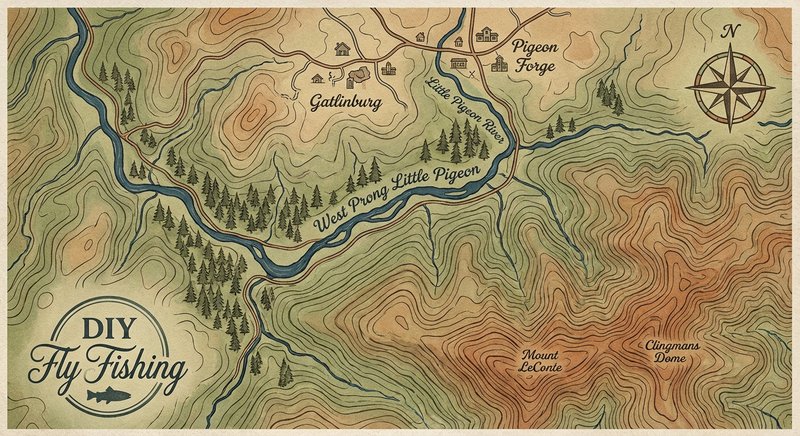
West Prong Little Pigeon
Fly fishing in Tennessee · Beginner · Best seasons: Spring, Summer, Fall
Target Species
Rainbow Trout, Brook Trout
About This Water
Gatlinburg area stream with wild trout. Good access from Newfound Gap Road.
Fishing Recommendations
Welcome to the Great Smoky Mountains National Park (GSMNP). As your guide, I can tell you that the West Prong of the Little Pigeon River is one of the most iconic "high-gradient" freestone streams in the Eastern United States.
It is a rugged, beautiful, and sometimes humbling piece of water that offers quintessential Southern Appalachian fly fishing.
🎣 Location Overview
The West Prong of the Little Pigeon is the primary drainage for the Tennessee side of the Smokies, running parallel to Newfound Gap Road (US-441). What makes this water special is its dramatic gradient. It drops quickly over massive boulders, creating endless "pocket water"—small, oxygenated pools and plunges.
Anglers love the West Prong because of its accessibility and its diversity. You can fish right off the road near the Chimneys Picnic Area or hike into the headwaters for a wilderness experience. The water is gin-clear, cold, and incredibly nutrient-poor, which means the fish are wild, opportunistic, and stunningly beautiful.
🐟 Target Species & Behavior
- Rainbow Trout: These are the primary residents from the park boundary up to about 3,000 feet in elevation. They are "pocket water" specialists. They hold in the soft water behind boulders, in the "pillows" in front of rocks, and along the seams of fast current. They are aggressive and must make split-second decisions to eat before the current sweeps the food away.
- Brook Trout (Southern Appalachian Strain): Known locally as "Specs," these are the only trout native to the Smokies. You will find them in the higher elevations (generally above the Chimneys or in tributaries like Road Prong). They are smaller (5–8 inches), incredibly colorful, and inhabit the tightest, coldest headwaters.
- Behavior: Because these streams are "infertile" (low mineral content/food), the fish aren't usually picky about hatch matching, but they are extremely spooky. If they see your shadow or your fly line splashes, the pool is "done" for thirty minutes.
📅 Best Times to Fish
- Spring (March – May): This is the prime window. As the water hits 50°F, the insects wake up. You’ll see the famous Quill Gordon and March Brown hatches.
- Summer (June – August): Excellent dry fly fishing, but you must head to higher elevations to find water below 65°F. This is "Terrestrial Season"—beetles and ants are king.
- Fall (September – early November): The water levels are often low and clear. The Brook Trout take on intense spawning colors. Blue-Winged Olives (BWO) become the primary hatch on overcast days.
- Optimal Window: In the spring/fall, 10:00 AM to 4:00 PM is best. In the heat of summer, focus on the "blue light" hours of early morning and late evening.
🪰 Recommended Flies & Techniques
Top Fly Patterns
- Dry Flies:
- Yellow Stimulator (Size 12-16): The absolute gold standard for the Smokies. It mimics stoneflies and looks like a "big meal."
- Parachute Adams (Size 14-18): The best generalist imitator.
- Elk Hair Caddis (Tan/Orange): Great for skittering across riffles.
- Royal Wulff: High visibility in the white water.
- Nymphs:
- Pheasant Tail (Size 14-18): Mimics almost any mayfly.
- Prince Nymph (Bead-head): Great for getting deep in the plunges.
- Terrestrials:
- Black Foam Beetles and Cinnamon Ants.
Techniques & Presentation
- The Dry-Dropper: This is the most effective rig. Tie a buoyant dry fly (like a Stimulator) and hang a small nymph 12–18 inches below it on 5X or 6X tippet.
- High-Sticking: Due to the complex currents, you want as little fly line on the water as possible. Keep your rod tip high and "lead" the fly through the pocket.
- The "One-Cast" Rule: In small pockets, your first cast is your best chance. Accuracy is more important than distance.
💡 Pro Tips & Local Knowledge
- Focus on the Chimneys: The stretch around the Chimneys Picnic Area offers some of the best pocket water for Rainbows. If you want Brookies, hike up Road Prong (the trailhead is near the Chimneys).
- Stealth is Everything: Wear drab colors (olive or tan) to blend into the forest. Approach a pool from downstream, staying low (sometimes on your knees). If you stand on top of a boulder overlooking a pool, the fish will see you before you see them.
- The "Smoky Mountain Roll": Overhanging rhododendrons make back-casting nearly impossible. Master the roll cast and the "bow-and-arrow" cast to get into tight spots.
- Watch the Rocks: The rocks in the West Prong are notoriously slippery. Felt-soled boots or studs are highly recommended to avoid a dunking.
⚠️ Important Information
- Licenses: You need a valid Tennessee OR North Carolina fishing license. Either one is valid throughout the Great Smoky Mountains National Park.
- Regulations:
- Artificial Lures Only: No corn, bread, or powerbait.
- Single Hook Only: No treble hooks.
- Size Limits: There is a 7-inch minimum size limit for kept trout, but most anglers in the park practice 100% Catch and Release to preserve the wild populations.
- Wildlife: This is bear country. Keep your lunch in a bear-proof container or your vehicle.
- Water Safety: Be wary of "flash floods." If the water starts to turn muddy or rises suddenly, exit the stream immediately. High-elevation storms can cause rapid rises even if it isn't raining where you are standing.
Bug Hatches & Matching Flies
| Hatch | Type | Peak months | Time of day | Hook sizes | Matching flies |
|---|---|---|---|---|---|
| Quill Gordon Epeorus pleuralis | mayfly | March, April | Midday | #12-14 | Quill Gordon Dry #12-14, Quill Gordon Wet #12-14 |
| Blue-Winged Olive Baetis spp. | mayfly | February, March, October, November | Midday/Afternoon | #18-22 | Parachute Adams #18-22, RS2 #20-22, Pheasant Tail #18-22 |
| March Brown Maccaffertium vicarium | mayfly | April, May | Afternoon | #10-14 | March Brown Western #12-14, Gold Ribbed Hare's Ear #10-14 |
| Yellow Sally Isoperla spp. | stonefly | May, June, July | Late Afternoon/Evening | #14-16 | Yellow Stimulator #14-16, Yellow Sally Nymph #14-16 |
| Light Cahill Stenonema/Stenacron | mayfly | May, June, July | Evening | #12-16 | Light Cahill Dry #12-16, Cream Variant #14-16 |
| Golden Stonefly Acroneuria spp. | stonefly | June, July | Morning/Evening | #8-12 | Golden Stone Nymph #8-12, Kaufmann's Stone #8-10 |
| Cinnamon Caddis Hydropsyche spp. | caddis | May, June, August, September | Evening | #14-18 | Elk Hair Caddis (Tan) #14-18, Soft Hackle Cinnamon #16 |
| Terrestrials (Ants and Beetles) Formicidae / Coleoptera | terrestrial | June, July, August, September | All Day | #12-18 | Black Foam Beetle #14-16, Cinnamon Ant #16-18 |