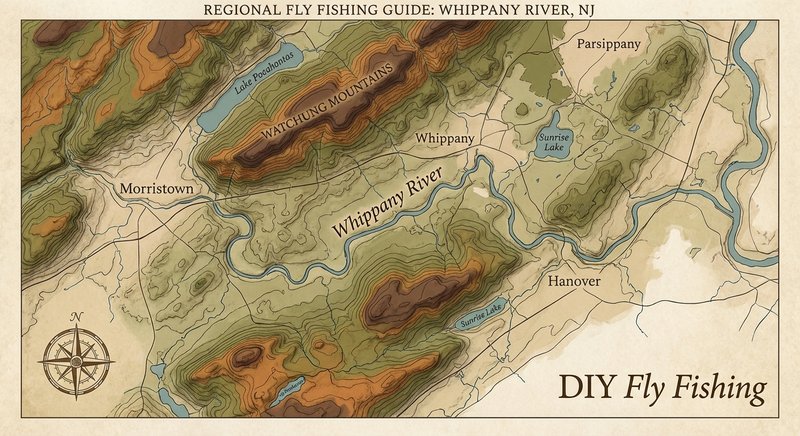
Whippany River
Fly fishing in New Jersey · beginner · Best seasons: spring
Target Species
Brown Trout, Rainbow Trout
About This Water
Morris County suburban stream with good trout stocking. Multiple park access points.
Fishing Recommendations
As an expert guide who has spent years navigating the suburban gems of the Mid-Atlantic, I can tell you that the Whippany River in Morris County, New Jersey, is a fascinating study in "backyard" fly fishing. While it flows through one of the most densely populated areas of the state, it offers a surprisingly scenic and productive experience for the angler who knows how to read its currents.
Here is your comprehensive guide to fly fishing the Whippany River.
🎣 Location Overview
The Whippany River is a classic low-gradient, suburban freestone stream. What makes it special is its resilience; despite being surrounded by office parks and residential neighborhoods, the river maintains a decent canopy and offers deep pools, undercut banks, and sections of gravelly riffles.
Anglers love the Whippany for its accessibility. It is one of the few places in North Jersey where you can squeeze in a "power hour" of fishing before or after work. The water character is generally slow to medium-paced, with a darker, tea-colored tint due to the surrounding wetlands and urban runoff. It feels intimate, requiring stealth and precise casting rather than long-distance bombs.
🐟 Target Species & Behavior
The Whippany is primarily a Put-and-Take fishery, heavily stocked by the NJ Division of Fish and Wildlife.
- Rainbow Trout: These are the primary residents in the spring. They tend to hold in the faster oxygenated water at the heads of pools and in the middle of the main current. They are opportunistic and will often move to intercept a fly.
- Brown Trout: You will find stocked Browns, but there is also a small population of "holdover" fish that have survived a season or two. These fish are much warier. They hold tight to submerged timber, undercut banks, and the darkest parts of the deep pools.
- Behavior: Early in the spring, these fish are concentrated near stocking points (bridges and parks). As the season progresses and water temperatures rise, they disperse. They feed primarily on aquatic invertebrates (midge larvae, scuds) and small baitfish (blacknose dace).
📅 Best Times to Fish
Optimal Seasons
- Spring (April – Early June): This is the "Golden Era" for the Whippany. Stocking begins in early April, and water temperatures are ideal (50°F–60°F).
- The "Sweet Spot": Mid-May. This is when the insect activity peaks and the fish have acclimated to the river.
Best Times of Day
- Early Morning: Best for streamers and targeting those larger holdover Browns.
- Late Afternoon/Evening: This is when the Whippany’s modest hatches occur. Look for "rises" in the flat water of the pools during the last hour of daylight.
Conditions
- Post-Rain: The Whippany can get muddy quickly. However, as the water begins to clear (the "tannic" stage), fishing with large nymphs or streamers can be incredibly productive as the fish feel protected by the turbidity.
🪰 Recommended Flies & Techniques
Top Fly Patterns
- Nymphs:
- Pheasant Tail (size 14-18): A staple for mimicking the mayfly nymphs.
- Gold-Ribbed Hare’s Ear (size 12-16): Great for the "buggy" look.
- Zebra Midge (size 18-22): Essential for when the fish get picky in the slow pools.
- Dry Flies:
- Adams/Parachute Adams (size 14-18): The best general searcher.
- Elk Hair Caddis (size 14-16): Effective in the riffles.
- Sulfurs (size 16-18): Crucial for late May evenings.
- Streamers:
- Woolly Bugger (Black or Olive, size 8-12): The most effective fly on this river, especially in moving water.
Effective Techniques
- Tight-Line/Euro Nymphing: Very effective in the riffles near Speedwell Lake and the patches of moving water in Morristown.
- Indicator Nymphing: The standard approach for the deeper, slower pools. Use a small, sensitive indicator.
- The "Swing": Swinging a small Woolly Bugger or a wet fly through the tail-outs of pools is a deadly local secret.
💡 Pro Tips & Local Knowledge
- Focus on the "Pockets": Because the river is low-gradient, any structure—a fallen log, a large rock, or a bridge abutment—will hold fish. Don’t just fish the big pools; fish the transitions.
- The Morristown Stretch: The area near Speedwell Lake and downstream through the parks in Morristown receives heavy stocking. If you want high numbers, start here.
- Stealth is Key: Because the water can be slow and shallow in places, avoid heavy wading. Fish from the bank when possible. Shadows and heavy footsteps will spook Whippany trout instantly.
- Urban Runoff Factor: If there is a heavy thunderstorm, give the river 24 hours to "settle." It drains a lot of pavement, which can lead to a temporary spike in temperature and turbidity.
⚠️ Important Information
Access Information
- Speedwell Park/Lake: Excellent access points with parking.
- Patriots’ Path: This trail system follows much of the river, providing miles of walking access to spots that don't get as much pressure as the bridge holes.
- Bee Meadow Park: Good access in the Hanover area.
Regulations & Permits
- License: A valid New Jersey Fishing License and a Trout Stamp are required for all anglers 16 and older.
- Closures: Be aware of the In-Season Stocking Closures. The Whippany is typically closed to fishing on specific weekdays during the spring (usually Mondays) until 5:00 PM on stocking weeks. Check the NJ Fish & Wildlife stocking schedule online.
Special Considerations
- Catch & Release: While much of the Whippany is a harvest-legal stream, I highly recommend catching and releasing the holdover fish to maintain the quality of the fishery.
- Wading: The bottom can be very silty and "mucky" in places. Use a wading staff if you are unfamiliar with the holes, as some drop-offs are sudden.
Tight lines, and enjoy this unique Morris County treasure!
Bug Hatches & Matching Flies
| Hatch | Type | Peak months | Time of day | Hook sizes | Matching flies |
|---|---|---|---|---|---|
| Blue-Winged Olive Baetis spp. | mayfly | April, May, September, October | Afternoon | #18-22 | RS2 #20-22, Parachute BWO #18-22, WD-40 #20-22 |
| Sulphur Ephemerella invaria/dorothea | mayfly | May, June | Evening | #14-18 | Pheasant Tail Nymph #14-18, Sulphur Parachute #14-18, Sulphur Snowshoe Emerger #16-18 |
| Tan Caddis Hydropsyche spp. | caddis | May, June, July | Morning/Evening | #14-18 | Elk Hair Caddis #14-16, LaFontaine's Deep Sparkle Pupa #14-18, Peeping Caddis #14-16 |
| Hendrickson Ephemerella subvaria | mayfly | April, May | Afternoon | #12-14 | Hendrickson Dark #12-14, Red Quill #12-14, Gold Ribbed Hare's Ear #12-14 |
| Light Cahill Stenonema/Stenacron spp. | mayfly | June, July | Evening | #12-14 | Light Cahill #12-14, Cream Variant #12-14 |
| Zebra Midge Chironomidae | midge | January, February, March, December | Anytime | #18-24 | Zebra Midge #18-22, Griffith's Gnat #20-24 |
| Trico Tricorythodes spp. | mayfly | July, August, September | Morning | #20-24 | Trico Spinner #22-24, Sunken Trico Spinner #22-24 |
| Terrestrials (Ants/Beetles) Formicidae/Coleoptera | terrestrial | July, August, September | Anytime | #12-18 | Black Foam Ant #14-18, Crowe Beetle #12-16 |