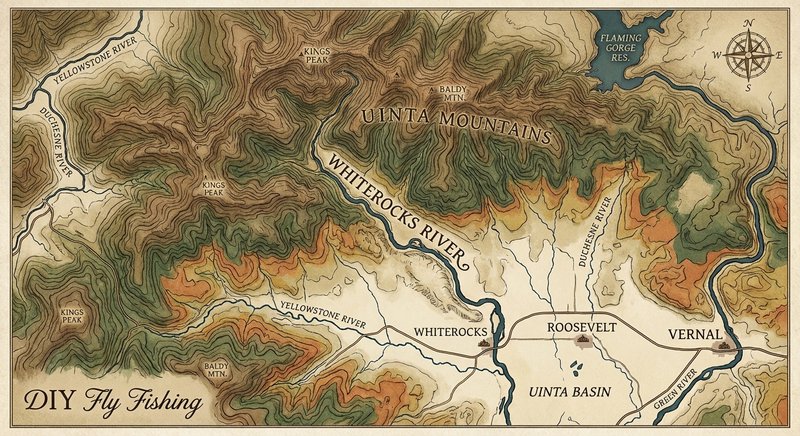
Whiterocks River
Fly fishing in Utah · Intermediate · Best seasons: Summer, Fall
Target Species
Cutthroat Trout, Brown Trout
About This Water
Remote Uinta stream with wild trout. Less pressured than nearby waters.
Fishing Recommendations
The Whiterocks River, located on the southern slopes of the Uinta Mountains in northeastern Utah, is a hidden gem for anglers who value solitude, rugged scenery, and hungry, wild trout. Flowing through a dramatic canyon before entering the Uintah and Ouray Indian Reservation, this river offers a classic freestone experience ranging from high-alpine meadows to pocket-water canyons.
As your guide, here is the comprehensive breakdown for fishing the Whiterocks.
🎣 Location Overview
The Whiterocks River is characterized by its diversity. In its upper reaches, it is a high-gradient mountain stream filled with boulders, plunge pools, and pocket water. As it moves downstream, it transitions into more accessible meadow sections.
What makes it special is the lack of crowds. While the nearby Green River attracts thousands, the Whiterocks offers a "backcountry" feel even in its more accessible stretches. The water is crystal clear, cold, and highly oxygenated—the perfect habitat for native Cutthroats. Anglers love it because the fish are generally "honest"; if you make a good drift with a reasonable fly, they will usually rise.
🐟 Target Species & Behavior
- Colorado River Cutthroat Trout: These are the stars of the upper river. They are opportunistic feeders due to the short high-country growing season. They hold in the soft water behind boulders and in the tail-outs of pools.
- Brown Trout: Found more frequently in the lower canyon and the stretches approaching the valley floor. They are more predatory and wary than the Cutthroats.
- Brook Trout: You will encounter these in the higher elevations and tributary creeks; they are small but vibrantly colored.
Behavior: Because this is a high-elevation freestone, the fish are keyed into the surface from July through September. They aren't usually "selective" about exact patterns, but they are very sensitive to shadows and heavy wading.
📅 Best Times to Fish
Optimal Seasons
- Summer (July – August): This is prime time. Runoff usually subsides by late June or early July. This is the window for peak dry-fly action and terrestrial fishing.
- Fall (September – October): My personal favorite. The Brown trout become aggressive as they prepare to spawn, and the Cutthroats are feeding heavily to bulk up for winter. The cottonwoods and aspens turning gold make for a spectacular backdrop.
Best Times of Day
- Summer: 9:00 AM to 11:00 AM (nymphing) and 4:00 PM to sunset (the "magic hour" for dries).
- Fall: Mid-day is best. Wait for the water to warm up slightly (11:00 AM to 4:00 PM).
🪰 Recommended Flies & Techniques
Top Fly Patterns
- Dry Flies:
- Stimulators (Orange or Yellow, size 12-16): Mimics stoneflies and grasshoppers.
- Parachute Adams (Size 14-18): The gold standard for any mountain stream.
- Royal Wulff: High visibility in bubbly pocket water.
- Chubby Chernobyl: Excellent as the "dry" in a dropper rig.
- Nymphs:
- Bead-head Prince Nymph (Size 14-16): High visibility and weight.
- Pheasant Tail (Size 16-20): Mimics the small mayflies present in the system.
- Zebra Midge (Red or Black): Great for slower pools.
- Streamers:
- Woolly Bugger (Olive or Black, size 8-12): Effective for the larger Browns in the lower stretches.
Techniques & Presentation
- Dry-Dropper Rig: This is the most effective way to fish the Whiterocks. Use a buoyant dry fly (like a Chubby) with 18-24 inches of 5X tippet leading to a weighted nymph.
- Short Line Nymphing: In the canyon sections, long casts are your enemy. Use a "high-stick" technique to keep your line off the complex currents and get a natural drift in the small pockets.
- Stealth: The water is exceptionally clear. Wear natural colors (tan/olive) and avoid "crunching" rocks as you approach a pool.
💡 Pro Tips & Local Knowledge
- Look for the "Slow in the Fast": On the Whiterocks, the fish don't want to fight the heavy current. Look for the tiny "buckets" of calm water directly behind large rocks or right against the bank. A 2-foot drift is often all you need.
- The "Hoppertunity": In late August, the meadow sections are loaded with grasshoppers. Don't be afraid to slap a large foam hopper right against the bank. The "plop" often triggers a strike from the biggest fish in the hole.
- Wading Safety: The rocks in the Whiterocks can be notoriously slick and unstable. I highly recommend felt-soled boots or studs, and a wading staff if you plan on trekking through the canyon.
⚠️ Important Information
Access
- Upper River: Accessible via Forest Service roads out of Whiterocks or Roosevelt. The Whiterocks Campground area provides good access points.
- Lower River: Much of the lower river flows through the Uintah and Ouray Indian Reservation.
Regulations & Permits
- Tribal Permits: If you are fishing on Reservation land, a Ute Tribal Fishing Permit is required. A standard Utah State license is not valid on tribal lands. Check maps carefully to ensure you know whose land you are on.
- State Regulations: On Forest Service land, standard Utah Division of Wildlife Resources (DWR) rules apply. Always check the current Utah Fishing Guidebook for specific creel limits or seasonal closures.
Special Considerations
- Bear Country: This is Black Bear territory. Keep a clean camp and consider carrying bear spray if you are hiking deep into the canyon.
- Flash Floods: During the summer "Monsoon" season (July/August), be wary of afternoon thunderstorms. High-walled canyons are not the place to be during a heavy downpour.
Bug Hatches & Matching Flies
| Hatch | Type | Peak months | Time of day | Hook sizes | Matching flies |
|---|---|---|---|---|---|
| Blue Winged Olive Baetis | mayfly | April, May, September, October | Late Morning/Afternoon | #18-22 | BWO Sparkle Dun #18-20, Pheasant Tail #18-22, RS2 #20-22 |
| Pale Morning Dun Ephemerella excrucians | mayfly | June, July, August | Late Morning | #14-18 | PMD Parachute #16-18, Split Case PMD #16-18, Quigley Cripple #16-18 |
| Golden Stonefly Hesperoperla pacifica | stonefly | June, July | All Day/Evening | #8-12 | Chubby Chernobyl (Gold) #8-12, Pat's Rubber Leg #8-12, Picket Pin #10-12 |
| Spotted Sedge Hydropsyche | caddis | July, August, September | Evening | #14-18 | Elk Hair Caddis #14-18, LaFontaine's Deep Sparkle Pupa #14-16, Goddard Caddis #14-16 |
| Western Green Drake Drunella doddsii | mayfly | July | Afternoon | #10-12 | Green Drake Parachute #10-12, Hare's Ear Nymph #10-12, Drake Cripple #12 |
| Terrestrials Orthoptera / Formicidae | terrestrial | July, August, September | Midday | #10-16 | Dave's Hopper #10-14, Carpenter Ant #14-16, Foam Beetle #14-16 |
| Mother's Day Caddis Brachycentrus | caddis | May | Afternoon | #14-16 | Peacock Caddis #14-16, Holy Grail #14-16 |
| Midges Chironomidae | midge | March, April, November | All Day | #20-24 | Zebra Midge #20-22, Griffith's Gnat #20-24, Morgan's Midge #20-22 |