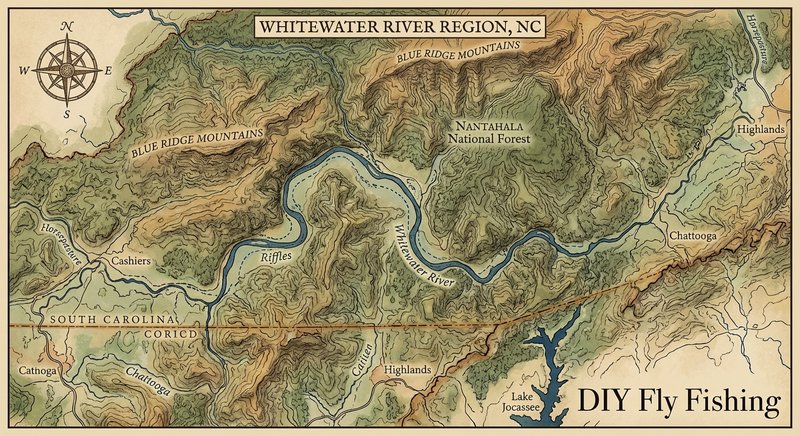
Whitewater River
Fly fishing in North Carolina · Intermediate · Best seasons: Spring, Summer, Fall
Target Species
Brown Trout, Rainbow Trout
About This Water
Scenic river near Cashiers with wild trout. Features dramatic waterfalls.
Fishing Recommendations
As your guide for the day, let me welcome you to one of the most rugged and breathtaking fly fishing destinations in the Blue Ridge Mountains. The Whitewater River in North Carolina is not for the faint of heart, but for the angler who values wild fish and solitude over easy access and high fish counts, it is a holy grail.
🎣 Location Overview
The Whitewater River is a high-gradient freestone stream located in the "Land of Waterfalls" near Cashiers and Sapphire, NC. It is famous for hosting the Upper Whitewater Falls, which drops over 400 feet and is the highest waterfall east of the Rockies.
What makes this water special is its dramatic topography. This is "pocket water" at its finest—a relentless staircase of plunges, deep pools, and massive granite boulders. The water is gin-clear and remains cold year-round due to the high elevation and heavy canopy. Anglers love it because it demands high-level technical skill and physical stamina; you aren't just fishing here, you’re mountaineering with a fly rod.
🐟 Target Species & Behavior
The Whitewater is primarily a Wild Trout fishery. While you may find a few "stockies" near the bridge crossings, the heart of the river belongs to:
- Wild Rainbow Trout: These are the primary residents. They are exceptionally hardy, vibrant, and aggressive. They typically hold in the "cushion" in front of boulders or in the fast, oxygenated riffles.
- Wild Brown Trout: The "ghosts" of the Whitewater. The larger Browns hide in the dark recesses of deep plunge pools and under the massive undercut boulders. They are highly predatory and extremely wary of shadows.
Behavior: Because the water is so clear and the river is nutrient-poor compared to limestone streams, these fish are opportunistic. However, they have PhDs in spotting fisherman. If they see you, the session is over before it begins.
📅 Best Times to Fish
Optimal Seasons
- Spring (Mid-March – May): The "Golden Era." This is when the major hatches occur (Quill Gordons, March Browns). The fish are hungry after winter and the water levels are usually perfect.
- Summer (June – August): Excellent for high-elevation "blue-lining." While lower-elevation rivers get too warm, the Whitewater stays cool. This is the prime season for terrestrial fishing (ants, beetles).
- Fall (Late September – November): The Brown trout become aggressive as they prepare for the spawn. The foliage is world-class, though falling leaves can make drifting a fly frustrating.
Best Times of Day
- Early Morning: Best for the big Browns.
- Late Afternoon/Dusk: When the "Blue Winged Olives" or "Caddis" begin to dance.
- Overcast Days: The absolute best condition for the Whitewater. Clouds cut the glare on the water and make the trout feel secure enough to leave their rocky hideouts.
🪰 Recommended Flies & Techniques
Top Fly Patterns
- Dry Flies:
- Stimulators (Size 12-16, Orange or Yellow): Great for high-visibility in broken water.
- Elk Hair Caddis (Size 14-18): A staple for NC mountains.
- Parachute Adams (Size 16-20): The best generalist pattern for clear pools.
- Nymphs:
- Pheasant Tail (Size 16-18): Mimics almost any mayfly nymph.
- Frenchie/Perdigon (Size 14-16): Fast-sinking for those deep plunge pools.
- Streamers:
- Wooly Bugger (Black or Olive, Size 8-10): Swing these through the deep holes for larger Browns.
Effective Techniques
- The Dry-Dropper: This is the "bread and butter" technique here. Use a buoyant dry fly (like a Stimulator) and hang a weighted nymph (like a Bead-head Prince Nymph) 18–24 inches below it. It allows you to fish two water columns in the tight pocket water.
- High-Sticking: Due to the conflicting currents, you want as little fly line on the water as possible. Keep your rod tip high to prevent "drag."
- Stealth Approach: Fish upstream. Move slowly. Wear earthy colors (camo or olive) to blend into the rhododendrons.
💡 Pro Tips & Local Knowledge
- Short Rods are King: A 7.5-foot to 8.5-foot 3-weight or 4-weight rod is ideal. Anything longer will get tangled in the overhanging rhododendron "hells."
- The "One-Cast" Rule: In the crystal-clear pools, you often only get one chance. If you botch the first cast, the fish will likely spook. Observe the water for 2 minutes before you ever pull line off the reel.
- Focus on the "Tail-outs": While everyone fishes the "head" of the pool where the water falls in, wild trout often sit at the very back (the tail-out) of a pool to intercept insects before they wash over the next drop.
- Footwear: Do not attempt this river in rubber-soled boots without studs. The granite is notoriously "greasy." Felt soles (where legal) or carbide-studded boots are a safety requirement.
⚠️ Important Information
Access
- Upper Whitewater: Accessible via NC Hwy 281. There are parking areas near the bridge.
- Gorges State Park: Provides some trail access to the river, but expect a strenuous hike down (and an even tougher hike back up).
- Bad Creek (South Carolina Side): You can access the lower sections via the Bad Creek Hydro Station (Duke Energy), but this requires checking in at the gate and a long hike.
Regulations
- NCWRC Wild Trout Waters: Most of the Whitewater is classified as "Wild Trout Waters." This means:
- Lure/Fly: Artificial lures with a single hook only.
- Creel: 4 fish limit, minimum 7 inches (though most wild trout anglers practice 100% Catch & Release here).
- License: You need a valid North Carolina Fishing License with the "Trout" privilege. If you cross into the South Carolina portion below the falls, you must have a SC license.
Safety Considerations
- Flash Floods: This gorge catches a lot of rain. If the water starts to turn muddy or rises quickly, get to high ground immediately.
- Cell Service: Virtually non-existent. Tell someone where you are going and when you expect to be back.
- Wildlife: This is prime Black Bear and Copperhead territory. Stay alert.
Bug Hatches & Matching Flies
| Hatch | Type | Peak months | Time of day | Hook sizes | Matching flies |
|---|---|---|---|---|---|
| Quill Gordon Epeorus pleuralis | mayfly | March, April | Midday | #12-14 | Quill Gordon Dry #12-14, Quill Gordon Wet Fly #12-14 |
| Blue Winged Olive Baetis | mayfly | March, April, October, November | Afternoon | #18-22 | Parachute BWO #18-22, Pheasant Tail Nymph #18-20 |
| March Brown Maccaffertium vicarium | mayfly | April, May | Afternoon | #10-14 | American March Brown #10-12, Hare's Ear Nymph #10-14 |
| Yellow Sally Isoperla | stonefly | May, June, July | Late Afternoon/Evening | #14-16 | Yellow Sally Stone #14-16, Little Yellow Sloan #14-16 |
| Golden Stonefly Acronuria | stonefly | June, July | Evening | #8-12 | Pat's Rubber Legs #8-12, Stimulator (Yellow/Orange) #8-10 |
| Light Cahill Stenonema | mayfly | June, July, August | Evening | #12-16 | Light Cahill #12-16, Cream Usual #14-16 |
| Cinnamon Caddis Hydropsyche | caddis | May, June, September | Evening | #14-18 | Elk Hair Caddis (Tan) #14-18, Holy Grail Caddis #14-16 |
| Terrestrials Formicidae / Coleoptera | terrestrial | July, August, September | All Day | #12-18 | Chernobyl Ant #10-14, Black Foam Beetle #14-18 |
| Giant Black Stonefly Pteronarcys dorsata | stonefly | April, May | Night/Evening | #4-8 | Girdle Bug #6-8, Black Stimulator #8 |