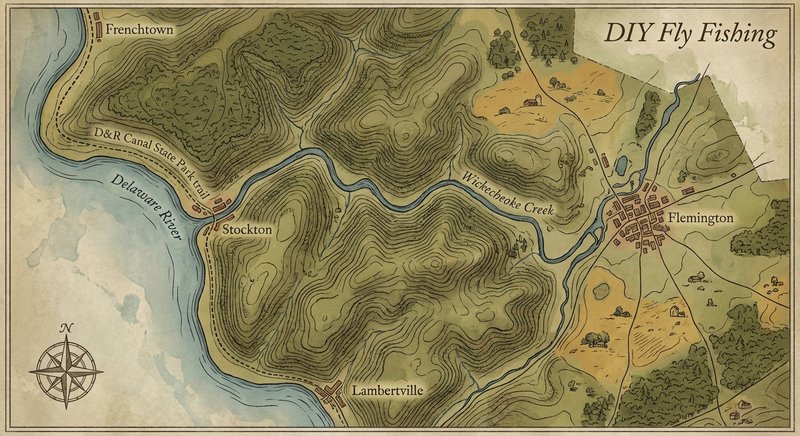
Wickecheoke Creek
Fly fishing in New Jersey · beginner · Best seasons: spring
Target Species
Brown Trout, Rainbow Trout
About This Water
Scenic Hunterdon County stream with covered bridge. Stocked trout and beautiful surroundings.
Fishing Recommendations
Wickecheoke Creek is one of Hunterdon County’s best-kept secrets. Flowing through the rolling hills of western New Jersey and eventually dumping into the Delaware River, this stream offers a quintessential Northeast "small water" experience. It is perhaps most famous for flowing under the Green Sergeant’s Covered Bridge, the last historic covered bridge in the state.
As an expert guide, I view the Wickecheoke as a "seasonal gem." While it doesn't hold the fame of the Musconetcong or the Ken Lockwood Gorge, its intimate size and scenic beauty make it a favorite for those who prefer solitude and technical small-stream tactics.
🎣 Location Overview
The Wickecheoke is a classic Piedmont freestone stream characterized by shale ledges, pocket water, and deep, slow pools. It winds through a mix of hardwood forests and agricultural lands.
What makes it special is its substrate. The creek bed is largely composed of red shale and argillite. This creates unique underwater "shelves" where trout love to hide. Unlike the boulder-strewn rivers of the Catskills, the Wickecheoke feels like a series of limestone-influenced meadow runs and jagged shale drops. It is intimate—rarely more than 20–30 feet wide—meaning stealth and short-range casting are the names of the game.
🐟 Target Species & Behavior
The Wickecheoke is primarily a stocked fishery, though you will occasionally find a "holdover" brown trout that survived a mild summer in a deep, spring-fed hole.
- Rainbow Trout: These are the most common. In the spring, they are aggressive and often found in the faster "oxygenated" water at the heads of pools or in riffles.
- Brown Trout: These fish are more selective. They gravitate toward the undercut shale banks and the dark shadows beneath overhanging trees or the covered bridge itself.
- Behavior: Freshly stocked fish (April) will take almost anything colorful. However, by mid-May, these fish become "stream smart." They will tuck into the tightest crevices of the shale ledges and require precise drifts to entice a strike.
📅 Best Times to Fish
The Wickecheoke is a Spring-centric fishery. Because it is a relatively shallow freestone stream, water temperatures can spike in the summer, making trout fishing unethical and unproductive after mid-June.
- Optimal Months: April and May. This coincides with the NJ Division of Fish & Wildlife stocking schedule and the peak of aquatic insect activity.
- Best Time of Day:
- Early Spring (April): Late morning to late afternoon (10:00 AM – 4:00 PM) when the sun warms the water enough to trigger bug activity.
- Late Spring (May): Early morning and "the magic hour" before dusk.
- Prime Conditions: Look for a "falling barometer" or 2-3 days after a rain event. If the water has a slight "tannin" or "tea" color, the fish lose their spookiness, and streamer fishing becomes deadly.
🪰 Recommended Flies & Techniques
Top Fly Patterns
- Nymphs:
- Pheasant Tail (Size 14–18): Matches the various Mayfly nymphs.
- Hare’s Ear (Size 12–16): Great general attractor.
- Zebra Midge (Size 18–22): Essential for when the water is low and clear.
- Dry Flies:
- Adams (Size 14–18): The gold standard for this creek.
- Elk Hair Caddis (Size 14–16): Tan or Olive; perfect for the riffles.
- Blue Winged Olive (Size 18–20): Essential on drizzly, overcast April days.
- Streamers/Attractors:
- Woolly Bugger (Black or Olive, Size 8–10): Swing these through the deep pools.
- Squirmy Worm / Mop Fly: Don't be a purist—if it's right after a stocking, these are high-percentage flies.
Effective Techniques
- High-Sticking / Tight-Line Nymphing: Because the current is complex with many micro-eddies around shale shelves, keeping your fly line off the water prevents drag.
- The "Dapping" Approach: In the brushy sections, you may not have room to cast. Creep up to the bank and drop your fly into the pockets.
- Dry-Dropper: A Size 14 Caddis with a Size 18 Pheasant Tail dropped 18 inches below is the most efficient way to cover Wickecheoke water in May.
💡 Pro Tips & Local Knowledge
- Focus on the Ledges: Wickecheoke trout don't just sit behind rocks; they sit under the shale ledges. If your nymph isn't getting down into those cracks, you're missing the fish.
- The Covered Bridge Pool: This is the most pressured spot on the creek. Everyone fishes it. If you want better results, hike a half-mile upstream or downstream from the bridge to find fish that haven't seen a dozen lures that morning.
- Stealth is Paramount: The water is often crystal clear. Wear earthy tones (olive/brown), avoid "shiny" gear, and stay low to the bank. If you can see the fish, they have likely already seen you.
- The Delaware Influence: Near the mouth where it joins the Delaware, you may catch "surprise" species like Smallmouth Bass or Fallfish, which can be a blast on a 3-weight fly rod.
⚠️ Important Information
- Access: Much of the land surrounding the creek is private. However, there are several key public access points managed by the NJ DFW and the Delaware Township. The Green Sergeant’s Covered Bridge (Route 604) and the Lockatong Preserve areas nearby are good starting points. Always look for "Green Acres" or "NJ Fish & Wildlife" signs.
- Regulations:
- A New Jersey Fishing License and Trout Stamp are required for everyone 16 and older.
- The Wickecheoke is a Stocked Water. It is typically closed to fishing for a period in early April prior to Opening Day (check the current NJ Freshwater Fishing Digest for specific dates).
- Wading: The shale can be incredibly slippery. I highly recommend felt-soled boots or rubber soles with carbide studs. A wading staff is a good idea for older anglers, as the shale ledges can drop off unexpectedly.
Guide’s Final Word: The Wickecheoke isn't where you go to catch a 24-inch trophy; it’s where you go to enjoy the scenery of old Hunterdon County, practice your technical casting, and appreciate the charm of a small New Jersey freestone stream. Tight lines!
Bug Hatches & Matching Flies
| Hatch | Type | Peak months | Time of day | Hook sizes | Matching flies |
|---|---|---|---|---|---|
| Blue-Winged Olive Baetis spp. | mayfly | March, April, September, October | Afternoon | #18-22 | RS2 #18-22, Parachute BWO #18-20, Pheasant Tail #18-20 |
| Quill Gordon Epeorus pleuralis | mayfly | April | Midday | #12-14 | Quill Gordon Dry #12-14, Gold Ribbed Hare's Ear #12-14 |
| Hendrickson Ephemerella subvaria | mayfly | April, May | Afternoon | #12-14 | Red Quill #12-14, Hendrickson Emerger #12-14, Pheasant Tail #12-14 |
| Sulphur Ephemerella invaria/dorothea | mayfly | May, June | Evening | #14-18 | Sulphur Parachute #14-18, CDC Sulphur Emerger #16-18 |
| Tan Caddis Hydropsyche spp. | caddis | May, June | Evening | #14-16 | Elk Hair Caddis #14-16, LaFontaine's Deep Sparkle Pupa #14-16 |
| Light Cahill Stenacron interpunctatum | mayfly | June, July | Evening | #12-14 | Light Cahill #12-14 |
| Trico Tricorythodes spp. | mayfly | July, August, September | Morning | #22-26 | Trico Spinner #22-24, Zebra Midge #22 |
| Black Ants & Beetles Formicidae / Coleoptera | terrestrial | July, August, September | All Day | #14-18 | Black Foam Ant #16-18, Crowe Beetle #14-16 |