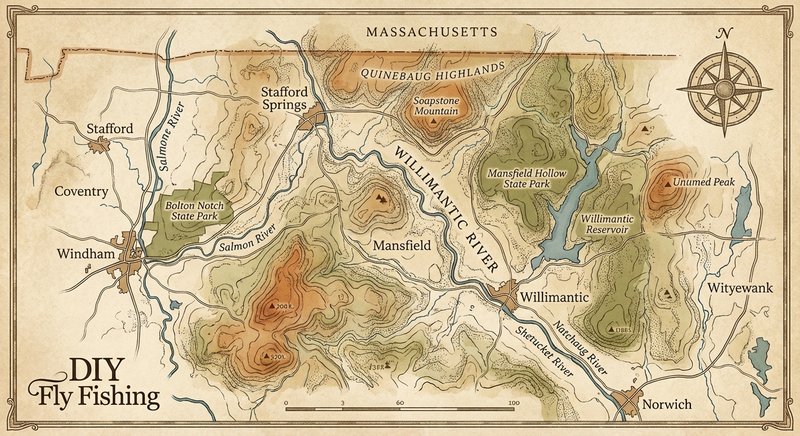
Willimantic River
Fly fishing in Connecticut · Beginner · Best seasons: Spring, Summer, Fall
Target Species
Brown Trout, Rainbow Trout
About This Water
Eastern Connecticut stream with brown trout. Good hatches and public access.
Fishing Recommendations
The Willimantic River is one of Eastern Connecticut’s premier fly fishing destinations. Flowing through the rolling hills of Tolland and Windham counties, it offers a classic New England freestone experience. While it may not have the fame of the Farmington or the Housatonic, it is a "guide’s favorite" because it offers diverse water types and a highly productive Trophy Trout Conservation Area (TTCA).
🎣 Location Overview
The Willimantic is a quintessential freestone river, meaning its flow and temperature are dictated by precipitation and ambient air temperature. What makes it special is the Trophy Trout Conservation Area, a nearly 9-mile stretch from the Route 74 bridge (Tolland/Willington) down to the hop river confluence.
The river is characterized by a mix of fast-moving pocket water, classic riffle-run-pool sequences, and long, glassy flats. It feels more intimate than Connecticut's larger rivers, offering anglers the chance to pick apart specific structures. The banks are largely forested, providing good shade that helps keep water temperatures stable longer into the summer than other nearby streams.
🐟 Target Species & Behavior
- Brown Trout: The "kings" of the Willimantic. While many are stocked, the river has excellent "holdover" potential. These fish become wary and highly selective. They prefer deep undercut banks, the "cushion" in front of large boulders, and deep tail-outs during the evening.
- Rainbow Trout: Generally more aggressive and found in faster, highly oxygenated water. Look for rainbows in the "white water" or the heads of pools where the current is swiftest.
- Behavior: Early in the season, fish are less cautious and will hit bright attractors. As the season progresses and the water clears, they move into "lie" positions where they can maximize calorie intake while minimizing energy expenditure.
📅 Best Times to Fish
- Spring (April – June): This is the prime window. The river is heavily stocked, and the major hatches occur now. Water levels are usually high but fishable.
- Summer (July – August): Fishing becomes a "dawn and dusk" game. You must carry a thermometer; if water temps exceed 68°F, stop fishing to protect the trout. Focus on the riffles where oxygen is highest.
- Fall (September – November): A spectacular time to be on the water. Brown trout become aggressive as they prepare to spawn. The crowds thin out, and the "Blue Winged Olive" hatches provide excellent dry fly action.
- Best Time of Day: In Spring/Fall, 10:00 AM to 4:00 PM is best. In Summer, 5:00 AM to 9:00 AM and 7:00 PM until dark (the "magic hour") are the only productive windows.
🪰 Recommended Flies & Techniques
Top Fly Patterns
- Dry Flies: Hendrickson (April), Light Cahill (May), Tan/Olive Caddis (All season), Blue Winged Olives (Cloudy days), and Terrestrials (Ants/Beetles in August).
- Nymphs: Bead-head Pheasant Tails (#14-18), Hare’s Ear (#12-16), Pat’s Rubber Legs (for high water), and Zebra Midges (#18-22).
- Streamers: Woolly Buggers (Olive or Black), Black Ghost, and small sculpin patterns.
Effective Techniques
- Euro Nymphing: Because the Willimantic has so much pocket water and varying current seams, a tight-line/Euro nymphing setup is incredibly effective. It allows you to get flies deep into the pockets behind rocks where fish hold.
- Dry-Dropper: A fantastic choice for the Willimantic in June. Use a buoyant Hopper or Klinkhammer as your "bobber" and hang a small Pheasant Tail 18 inches below it.
- Swinging Streamers: On higher water days, swinging a streamer across and down through the deeper runs can trigger violent strikes from larger holdover Browns.
💡 Pro Tips & Local Knowledge
- Focus on Mansfield/Willington: The stretch along River Road in Mansfield offers some of the best access and most diverse water. There are several pulloffs that lead to classic "pool and drop" water.
- The "Caddis Hatch": The Willimantic has a prolific caddis population. If you see fish rising but they won't take your dry fly, try "skating" your caddis (giving it short twitches) to mimic the natural insect's movement.
- Stealth Matters: By July, the water is crystal clear. Long leaders (12ft+) and 6X or 7X fluorocarbon tippet become necessary. Approach pools from downstream and stay low to the bank to avoid shadowing the fish.
- The Eagleville Section: The water just below the Eagleville Dam can hold very large fish, but it is heavily pressured. Fish here on weekdays or during inclement weather for the best results.
⚠️ Important Information
- Regulations: The section from the Rt. 74 bridge down to the Hop River confluence is a Trophy Trout Conservation Area.
- Rules: 2 fish limit, 9-inch minimum length.
- Note: Many local anglers practice 100% Catch and Release here to maintain the quality of the fishery.
- Permits: A valid Connecticut Fishing License and a Trout & Salmon Stamp are required for all anglers 16 and older. These can be purchased online via the CT DEEP website.
- Access: Much of the river parallels the Willimantic River Hiking Trail. This is a great resource for finding "hidden" holes away from the main road crossings.
- Safety: The rocks in the Willimantic are notoriously "greasy." Felt-soled wading boots or studs are highly recommended to avoid slipping.
The Willimantic is a gem of the "Quiet Corner" of Connecticut. Treat the fish with respect, keep them in the water, and you'll find this river to be a rewarding challenge!
Bug Hatches & Matching Flies
| Hatch | Type | Peak months | Time of day | Hook sizes | Matching flies |
|---|---|---|---|---|---|
| Blue Winged Olive Baetis / Acerpenna | mayfly | April, May, September, October | Midday | #18-22 | BWO Sparkle Dun #18-22, RS2 #20-22, Pheasant Tail #18-20 |
| Hendrickson Ephemerella subvaria | mayfly | April, May | Afternoon | #12-14 | Hendrickson Dark #12-14, Red Quill #14, Hendrickson Nymph #12-14 |
| Grannom Caddis Brachycentrus | caddis | April, May | Morning/Afternoon | #14-16 | Grannom Pupa #14-16, Elk Hair Caddis (Olive) #14-16, Peacock Caddis #16 |
| Light Cahill Stenacron / Stenonema | mayfly | June, July | Evening | #12-14 | Light Cahill #12-14, Cream Usual #14, Gold Ribbed Hare's Ear #14 |
| Sulfur Ephemerella invaria / dorothea | mayfly | May, June | Evening | #14-18 | Sulfur Parachute #14-18, Sulfur Emerger #16-18, Pheasant Tail (Flashback) #16 |
| Tan Caddis Hydropsyche | caddis | May, June, July, August | Evening | #14-18 | Elk Hair Caddis (Tan) #14-18, LaFontaine's Deep Pupa #16, Iris Caddis #14-16 |
| Ants and Beetles Formicidae / Coleoptera | terrestrial | July, August, September | All Day | #14-20 | Black Foam Ant #16-20, Cinnamon Ant #16-18, Black Beetle #14-16 |
| Common Midge Chironomidae | midge | January, February, March, December | Midday | #20-24 | Zebra Midge #20-22, Griffith's Gnat #20-24, Top Secret Midge #22 |
| Isonychia Isonychia bicolor | mayfly | June, September | Late Afternoon/Evening | #10-12 | Iso Parachute #10-12, Zug Bug #10-12, Prince Nymph #12 |