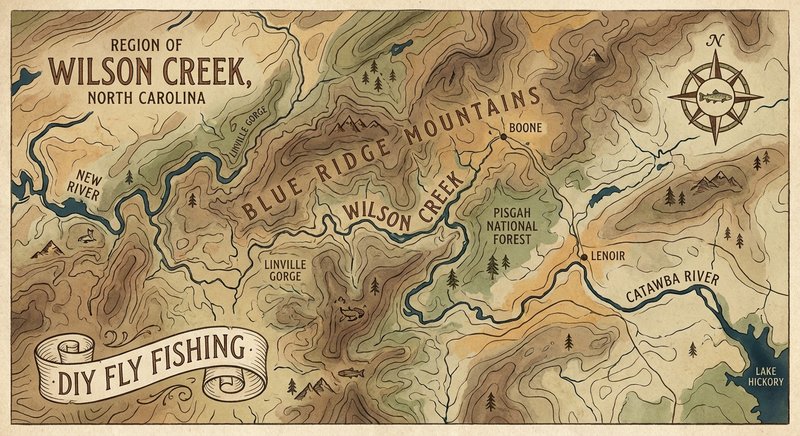
Wilson Creek
Fly fishing in North Carolina · Intermediate · Best seasons: Spring, Summer, Fall
Target Species
Brown Trout, Rainbow Trout
About This Water
Wild and scenic river with trophy brown trout. Excellent dry fly fishing.
Fishing Recommendations
Wilson Creek is one of the crown jewels of North Carolina fly fishing. Designated as a "National Wild and Scenic River," it flows from the flanks of Grandfather Mountain down through a rugged, boulder-filled gorge before leveling out in the valley. It offers a rare "triple threat" for anglers: a productive Delayed Harvest section, rugged wild trout water in the gorge, and pristine headwater tributaries.
🎣 Location Overview
Wilson Creek is characterized by its crystal-clear water and massive granite boulders. The landscape is dramatic—steep canyon walls, deep turquoise pools, and chaotic "pocket water" where the river tumbles over rock shelves.
Anglers love Wilson Creek because of its diversity. You can fish from the tailgate of your truck in the lower sections or hike miles into the backcountry to find wild trout that have never seen a fly. The water is highly oxygenated and stays cooler than many other NC streams, though it can become "technical" due to its extreme clarity.
🐟 Target Species & Behavior
- Rainbow Trout: Found throughout the system. In the Delayed Harvest (DH) section, they are abundant and often hold in the faster water at the heads of pools. Wild rainbows in the upper gorge are smaller but incredibly vibrant and aggressive.
- Brown Trout: The "kings" of the deep pools. Large, wild browns lurk in the undercut banks and under the shadows of giant boulders in the gorge. They are notoriously "spooky" and often require a stealthy approach and long, fine leaders.
- Behavior: Because the water is so clear, Wilson Creek trout have excellent vision. They hold tightly to "seams" (where fast and slow water meet). In the summer, they move into the fastest oxygenated "broken" water to stay cool.
📅 Best Times to Fish
- Spring (March – May): The Absolute Prime Window. This coincides with the best hatches (Quill Gordons, March Browns, and Hendricksons). The water temperatures are rising, and fish are hungry after winter.
- Summer (June – August): Focus on the Upper Gorge and Headwaters. While lower sections may get too warm, the shaded gorge remains productive. This is the time for "Dry-Dropper" rigs and terrestrial patterns.
- Fall (September – November): Another peak season. The Delayed Harvest section re-opens in October, providing high fish densities. Brown trout become more aggressive as they prepare for the spawn (late Oct/Nov).
- Time of Day: In the heat of summer, fish early (sunrise to 10 AM) or late (6 PM to dusk). In the Spring and Fall, the midday sun often triggers the best insect activity.
🪰 Recommended Flies & Techniques
Top Fly Patterns
- Dry Flies: Parachute Adams (#14-18), Yellow Sally Stonefly (#14-16), Elk Hair Caddis (Tan or Olive, #14-16), and Stimulators (#12-14) for the rough water.
- Nymphs: Pheasant Tail (#14-18), Prince Nymph (#12-16), and the Pat’s Rubber Leg (Girdle Bug) in black or coffee—this is a staple for the DH section.
- Terrestrials: Green Weenie, Foam Beetles, and Dave’s Hopper (crucial for Summer fishing).
- Streamers: Woolly Buggers (Olive or Black) and Sparkle Minnows. Use these in the deep pools of the gorge to find larger Browns.
Techniques
- High-Sticking/Euro Nymphing: Because the river is so rocky, "dead drifting" a nymph under an indicator can be difficult with complex currents. Keeping most of your fly line off the water helps prevent drag.
- Dry-Dropper: A buoyant dry fly (like a Stimulator) with a small nymph tied 18-24 inches below it is the most effective way to cover the "pocket water."
- Stealth: Wear natural colors (greens/browns) and move slowly. If you can see the fish in the clear pools, they have likely already seen you.
💡 Pro Tips & Local Knowledge
- The "Gorge" is Physical: Fishing the Wilson Creek Gorge is essentially "bouldering with a fly rod." Be prepared to scramble over rocks and hike steep trails. Felt-soled boots with metal studs are highly recommended for traction on the slick granite.
- Watch the Gauge: Wilson Creek rises extremely fast during rain events. Always check the USGS gauge at Adako before heading out. Anything over 200 cfs makes wading difficult; over 400 cfs is dangerous.
- Look for the "Bubbles": In the deep, clear pools, trout often sit right under the bubble line where the current brings food. Don't overlook the very tail-end of a pool right before it breaks into the next rapid.
- Tributaries: If the main stem is crowded, hike into Harper Creek or Lost Cove Creek. These are pristine wild trout waters that offer incredible solitude and stunning waterfalls.
⚠️ Important Information
- Access: The main access is via Brown Mountain Beach Road and Adako Road. There are numerous pull-offs, but they fill up fast on weekends.
- Regulations:
- Delayed Harvest (DH): A large section is managed under DH rules (Catch and Release only, single hook artificial lures only) from October 1 through the first Saturday in June.
- Wild Water: The upper sections and tributaries are "Wild Trout" waters—check current NC Wildlife Resource Commission (NCWRC) regulations for size and creel limits.
- Safety: Cell service is non-existent in the gorge. Let someone know where you are going. Also, be mindful of "tubers" in the lower sections during hot summer weekends—they can make fishing impossible in the lower valley, so head upstream!
Guide’s Final Word: Wilson Creek is a place that rewards the adventurous. If you are willing to walk an extra mile away from the road, you will find some of the most beautiful trout water in the Eastern United States. Tight lines!
Bug Hatches & Matching Flies
| Hatch | Type | Peak months | Time of day | Hook sizes | Matching flies |
|---|---|---|---|---|---|
| Quill Gordon Epeorus pluralis | mayfly | March, April | Mid-day | #12-14 | Quill Gordon Dry #12-14, Quill Gordon Nymph #12-14 |
| Blue Quill Paraleptophlebia adoptiva | mayfly | March, April | Mid-day to Afternoon | #16-18 | Blue Quill Dry #16-18, Pheasant Tail Nymph #16-18 |
| Hendrickson Ephemerella subvaria | mayfly | April | Afternoon | #12-14 | Hendrickson Dark #12-14, Red Quill Spinner #12-14 |
| Yellow Sally Isoperla spp. | stonefly | May, June, July | Late Afternoon/Evening | #14-16 | Yellow Sally Foam Stone #14-16, Little Yellow Stone Nymph #14-16 |
| Light Cahill Stenacron interpunctatum | mayfly | May, June | Evening | #12-14 | Light Cahill #12-14, Cream Usual #14 |
| Tan Caddis Hydropsyche | caddis | April, May, September | Morning/Evening | #14-18 | Elk Hair Caddis (Tan) #14-16, Holy Grail #14-16 |
| Blue Winged Olive Baetis spp. | mayfly | February, March, October, November | Mid-day | #18-22 | RS2 #20-22, BWO Sparkle Dun #18-20 |
| Golden Stonefly Acronuria | stonefly | June, July | Morning/Evening | #8-12 | Kaufmanns Stone (Golden) #8-12, Stimulator (Yellow/Orange) #10-12 |
| Terrestrials Various | terrestrial | July, August, September | All Day | #12-18 | Black Foam Beetle #14-16, Cinnamon Ant #16-18 |